

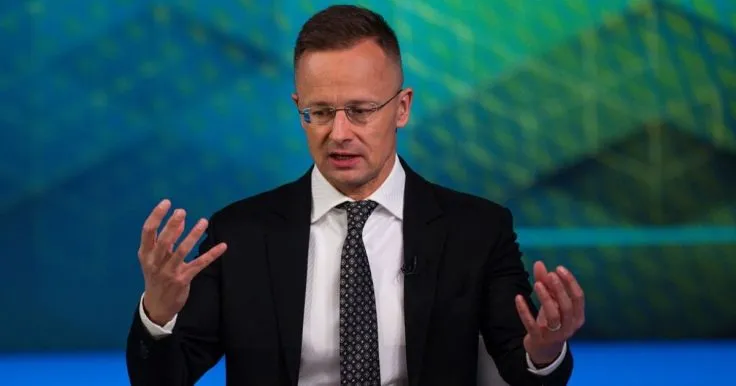
The Hungarian Minister of Foreign Affairs, Péter Szijjártó, commented for the first time on the results of the parliamentary elections in the country after a long pause in public statements. He emphasized that he did not work in the interests of the Russian Federation and did not betray his own country.
This is reported by Finway
Szijjártó explained Orbán’s party defeat by Ukraine’s influence
In his interview for the Hungarian portal Telex, Szijjártó stated that the defeat of Viktor Orbán’s political force in the elections, in his opinion, was made possible by Ukraine’s interference. The diplomat noted that a certain segment of Ukrainians was interested in the failure of the Fidesz party, led by Orbán.
«The election results reflect the will of Volodymyr Zelensky, Ukrainians were interested in the defeat of "Fidesz"», Szijjártó said.
He also reiterated Orbán’s previous statements about attempts to drag Hungary into the Russian-Ukrainian war, emphasizing that he fears a global shift towards the so-called “era of war”.
Szijjártó’s stance on participation in the war and relations with Russia
When asked about the possibility of personal involvement in combat actions if he receives a draft notice, the minister replied that at 48 years old he is unlikely to be deemed fit for service at the front, and he himself has no military experience. Szijjártó expressed hope that the new government would not involve the country in an armed conflict.
Journalists also inquired whether his close contacts with the Russian Federation could be classified as state treason, considering his frequent conversations with Sergey Lavrov, the Russian Foreign Minister, during discussions on sanctions within the EU. Szijjártó emphasized that he has never passed confidential information to the Kremlin and considers such accusations very serious.
The minister added that due to pragmatic relations with Russia, there are no strikes from the RF in the regions of Ukraine where the Hungarian community resides. Moreover, the “friendship” with the Kremlin has allowed Hungary to obtain cheap energy resources.
Szijjártó and Lavrov tapes: details of conversations
Journalistic investigations mention phone conversations between Szijjártó and Lavrov. In particular, in a conversation on August 30, 2024, Lavrov asked for help in removing the sister of oligarch Alisher Ismailov from the EU sanctions list. Ahead of the elections, another series of audio recordings was released, in which the Hungarian minister discusses with Lavrov the prospects of Ukraine’s accession to the European Union, sanctions issues, and other European topics.
In one of the fragments, Szijjártó agrees to pass a document regarding the role of minority languages in the negotiations on Ukraine’s Eurointegration at Lavrov’s request. The minister emphasized that foreign intelligence services were listening to the phone conversations with the assistance of Hungarian journalists, and these recordings continue to be released.