

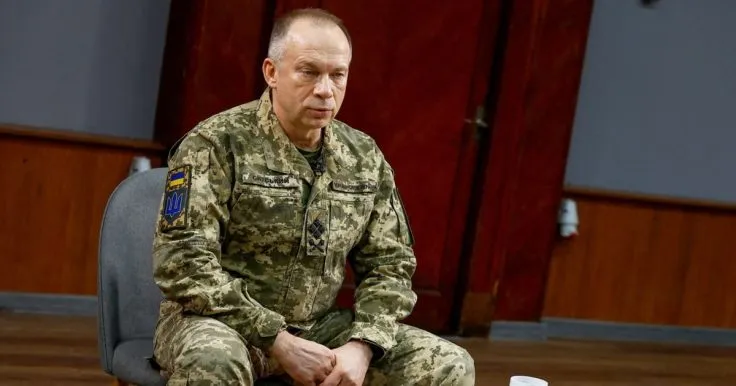
The Commander-in-Chief of the Armed Forces of Ukraine, Oleksandr Syrskyi, met on April 24 with Admiral Giuseppe Cavo Dragone, the head of NATO’s Military Committee, and General Sean Clancy, the head of the European Union Military Committee. This meeting took place against the backdrop of a deteriorating security situation and increasing pressure from Russia.
This is reported by Finway
The situation at the front and strikes on Russian infrastructure
During the negotiations, Syrskyi provided the delegation with a detailed update on the current state of affairs at the front line. He emphasized that Russian troops, despite significant losses in personnel, weapons, and equipment, continue their offensive actions. According to him, Ukrainian defense forces counter the enemy’s numerical superiority through qualitative approaches to combat, complicating the adversary’s ability to achieve strategic objectives and forcing them to operate under unfavorable conditions.
“Despite significant losses in personnel, weapons, and military equipment, the enemy does not abandon its offensive actions. To neutralize its numerical advantage, the Ukrainian Defense Forces employ qualitative approaches to combat, forcing the enemy to operate under unfavorable conditions and constantly delaying the timelines for achieving set objectives.”
According to the Commander-in-Chief, over the past four months, Ukrainian drone units have destroyed more enemy personnel than Russia is capable of mobilizing in the same period. In addition, special operations continue to target key military-industrial complex and military infrastructure facilities in Russia. Assessing the economic consequences of such actions, Syrskyi reported that the total direct and indirect losses for the enemy amount to 25.5 billion US dollars.
Ukraine’s defense needs and partner support
Particular attention during the meeting was paid to the critical needs of the Armed Forces of Ukraine. Syrskyi stressed that due to ongoing Russian attacks, air defense remains a top priority for the Ukrainian army. He thanked partners for their combined efforts under the PURL initiative, as well as for the work of the NATO Mission to Assist Ukraine (NSATU), which coordinates international military assistance, logistics, and military training. It was noted that within the framework of the EU Military Assistance Mission (EUMAM), over 90,000 Ukrainian servicemen have already been trained.
Syrskyi emphasized the strategic importance of Ukraine’s cooperation with the EU and NATO, highlighting the strengthening of security and the creation of conditions for a peaceful future.
The press service of the head of the EU Military Committee reported that during Clancy and Dragone’s visit, they also met with Deputy Foreign Minister Yevhen Perebyinis, NATO’s representative in Ukraine Patrick Turner, and EU Ambassador Katarzyna Maternowa. The EU Military Committee stated the importance of the mutual complementarity of the bloc and NATO in providing effective support to Ukraine:
“Coordinated, synchronized, and committed: support for Ukraine continues for as long as needed. Ukraine’s security remains central to Europe’s security.”
NATO Command refrained from commenting on the content of the meeting.
Earlier, President Volodymyr Zelensky, citing British intelligence, noted that the situation at the front for Ukraine is challenging but currently the best it has been in the last ten months. Analysts from the American Institute for the Study of War (ISW) stated at the end of March 2026 that significant successes for Russia at the front do not appear inevitable, let alone a complete victory for the aggressor.