

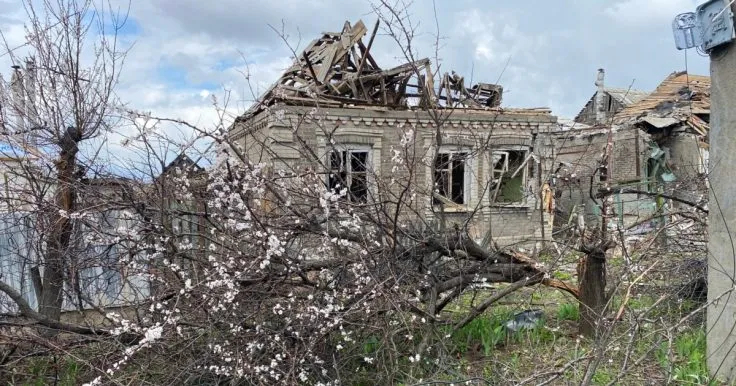
On the morning of April 26, the Russian Federation’s forces carried out an artillery shelling of Kramatorsk in the Donetsk region, resulting in the deaths of two civilians, and another person sustained serious injuries. This was reported by the local prosecutor’s office.
This is reported by Finway
Consequences of the Kramatorsk Shelling
As a result of the attack on residential areas of the city, a man and a woman were killed. According to the prosecutor’s office, at the time of the shelling, they were outside and sustained fatal injuries. In addition, a 50-year-old local resident suffered a mine-explosive injury, a fracture, and shrapnel wounds. He was hospitalized in serious condition.
“The munitions hit residential buildings. As a result of the enemy attack, the woman and man sustained injuries incompatible with life. At the time of the attack, they were outside,” the agency stated.
During the attack, eight residential buildings were damaged. The final list of the consequences of the shelling and the type of weapon used is currently being established. A criminal proceeding has been initiated for the war crime under part 2 of Article 438 of the Criminal Code of Ukraine.
Context: Russian Attacks on Civil Infrastructure
The Russian military continues to systematically shell Ukrainian cities with various types of weapons, including using strike drones, missiles, aerial bombs, and multiple launch rocket systems. Such attacks are regularly directed against civil infrastructure in different regions of the country.
The Ukrainian authorities and international human rights organizations classify such strikes as war crimes of the Russian Federation, emphasizing their targeted nature. Shelling of vital systems for the population and healthcare facilities, which leave people without electricity, water, heat, communication, and medical assistance, is considered particularly dangerous.
Human rights defenders note that such actions exhibit signs of genocide. Among them are public statements by Russian officials about intentions to destroy Ukrainians as a nation, carrying out targeted shelling of vital systems, persecuting people with pro-Ukrainian positions in occupied territories, deporting children to Russia, and destroying Ukrainian cultural heritage.
The Convention on the Prevention and Punishment of the Crime of Genocide, adopted by the UN in 1948, defines genocide as actions aimed at the complete or partial destruction of a national, ethnic, racial, or religious group. Signs of genocide include the killing of members of that group, causing them serious bodily harm, creating conditions for their destruction, as well as the forcible transfer of children and public incitement to such actions. Currently, 149 member countries have joined the Convention, which obliges them to prevent acts of genocide and hold perpetrators accountable in both wartime and peacetime.
At the same time, the leadership of the Russian Federation denies the fact of targeted strikes on civilian objects in Ukraine, despite numerous evidence of the destruction of hospitals, schools, kindergartens, energy and water supply facilities, as well as the deaths of civilians.