

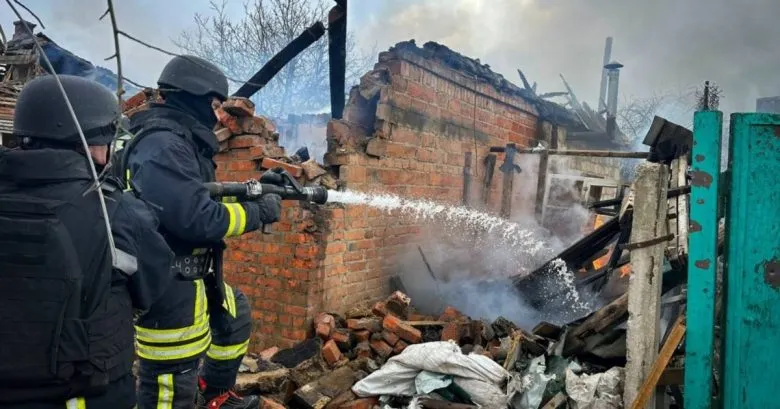
As a result of yet another attack by Russian military forces in the Kharkiv region, civilians were injured, including three children. On April 9, the Russians shelled the village of Zolochiv in the Bohodukhiv district using a multiple launch rocket system, resulting in five people being injured, including two elderly women and three children. This was reported by the State Emergency Service.
This is reported by Finway
Consequences of the shelling: destruction and injuries
During the attack, eight private households were severely damaged, and a fire broke out in a garage, which rescuers promptly extinguished. According to the head of the Kharkiv Regional Military Administration, Oleg Synegubov, among the injured is a 67-year-old woman with serious injuries who was hospitalized. Another 72-year-old woman experienced a stress reaction. The three children—a 13-year-old boy, a 16-year-old boy, and a 14-year-old girl—were in a state of severe stress, with one of the boys sustaining abrasions. All the victims received the necessary medical assistance.
“The 13-year-old boy has abrasions and an acute stress reaction, the 14-year-old girl and the 16-year-old boy experienced severe stress. The 72-year-old woman also had a stress reaction. Medical personnel provided all the necessary assistance,” he reported.
Systematic attacks and signs of genocidal actions
The Russian Federation continues to systematically shell cities and villages in Ukraine with various types of weaponry, including strike drones, missiles, aerial bombs, and multiple launch rocket systems. Civil infrastructure targets include energy facilities, water supply systems, medical institutions, and residential buildings.
Ukrainian authorities and international organizations regard such strikes as war crimes committed by the Russian Federation and emphasize their deliberate nature. The shelling of vital infrastructure and healthcare facilities, which deprives the population of electricity, heat, water, communication, and medical assistance, bears the hallmarks of genocidal actions.
Russian officials have repeatedly publicly stated their intentions to destroy Ukrainians as a nation, denying its existence, and calling for the elimination of the Ukrainian people. In addition to shelling, there are documented cases of persecution of pro-Ukrainian individuals in occupied territories, the destruction of the Ukrainian intelligentsia, the deportation of children, and the destruction of cultural heritage.
The UN Convention on the Prevention and Punishment of the Crime of Genocide, adopted in 1948, obliges the participating states (currently 149) to prevent acts of genocide and to punish them in both wartime and peacetime. The document defines genocide as acts aimed at the total or partial destruction of a national, ethnic, racial, or religious group, including killings, causing serious bodily or mental harm, creating living conditions intended to destroy the group, forcibly transferring children, and publicly inciting such crimes.
The authorities of the Russian Federation deny the facts of targeted attacks on Ukraine’s civilian infrastructure; however, repeated strikes on hospitals, schools, kindergartens, energy facilities, and water supply systems indicate otherwise.