

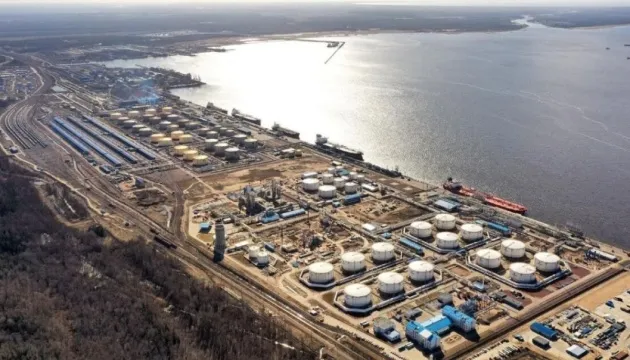
Oil exports from Russia in the last month decreased by approximately 1.8 million tons due to the impact of international sanctions and as a result of strikes on key Baltic ports. Despite these losses, the Russian Federation is trying to compensate for the decline in exports by seeking new supply routes for the raw material.
This is reported by Finway
Significant decline in export volumes due to sanctions and attacks
According to the President’s Commissioner for Sanctions Policy, Vladislav Vlasyuk, the sanction pressure on oil exports from Russia has yielded a noticeable result, particularly evident in the Baltic direction. According to the Institute for Black Sea Strategic Studies, in April, the volumes of oil exports from the Russian Federation decreased by 16.8%, or nearly 1.8 million tons, compared to March. The reason for this decline was the so-called “kinetic sanctions” — strikes on the ports of Primorsk and Ust-Luga, which are among the largest oil hubs in the country.
“There is a noticeable result from the sanction pressure on Russian oil exports – its reduction primarily in the Baltic direction,” Vlasyuk noted.
Russia seeks new export routes
Vladislav Vlasyuk emphasized that Russia is striving to compensate for the losses caused by the restrictions through other routes, particularly via the Black Sea, where an increase in unloading volumes is being recorded. However, the overall sanction pressure continues to affect the country’s export capabilities, contributing to a further decline in oil supplies abroad.
According to analysts’ estimates, attacks on oil refineries and ports in the Russian Federation have significantly hindered the development of this sector. In particular, according to data from the Institute for the Study of War, the oil refining industry in Russia has returned to the level of December 2009.