

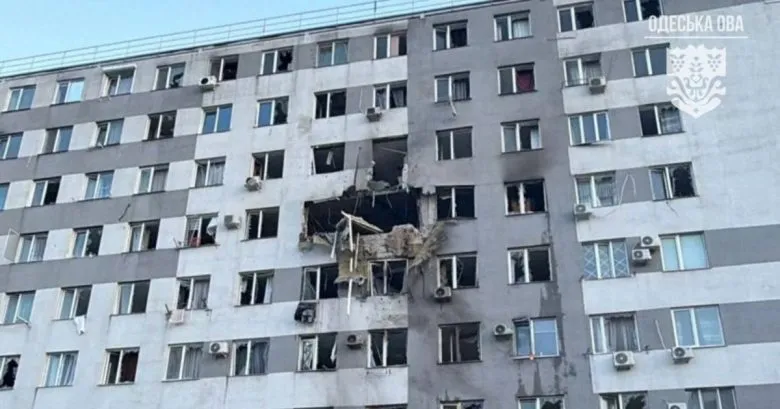
On the night of April 16, the Russian Federation launched a massive attack on Odesa, using missiles and strike drones. As a result, according to the head of the regional military administration, Oleg Kiper, seven people were killed, and at least 12 others sustained injuries of varying severity.
This is reported by Finway
Consequences of the Shelling and Response from Local Authorities
During the attack, the city experienced several waves of mixed missile-drone strikes, leading to extensive destruction. According to Kiper, facilities related to port, critical, and residential infrastructure were damaged. Significant harm was inflicted on at least three apartment buildings, with facade walls destroyed and windows shattered, as well as damage to a dormitory and adjacent structures. Fires broke out at some infrastructure sites, which municipal services are currently working to extinguish. An emergency headquarters has been quickly established in the city to coordinate rescue efforts.
“Unfortunately, seven people have died, and at least 12 have been injured. I express my heartfelt condolences to the families and loved ones of the deceased. The city’s port, critical, and residential infrastructure has been damaged.”
Systematic Attacks and International Assessment
Russian military forces regularly employ various types of weaponry — strike drones, missiles, aerial bombs, and multiple launch rocket systems — to attack Ukrainian cities, including civilian infrastructure. Ukrainian authorities and international organizations classify these actions as war crimes committed by the Russian Federation and emphasize their deliberate nature. Attacks on essential services for the population and medical facilities, which deprive people of electricity, heat, water, communication, and medical assistance, are considered by experts to be indicative of genocidal actions.
Human rights defenders, researchers, and lawyers point out that Russia is committing crimes during the large-scale war that may fall under the definition of genocide. Such actions include public calls for the destruction of Ukrainians, targeted attacks on civilians, persecution of citizens with pro-Ukrainian positions in occupied territories, extermination of the intelligentsia, deportation of children, and destruction of Ukrainian cultural heritage.
The Convention on the Prevention and Punishment of the Crime of Genocide, adopted by the UN General Assembly in 1948, obligates participating countries (currently 149) to prevent acts of genocide and to punish them in both wartime and peacetime. The document defines genocide as actions aimed at the complete or partial destruction of a national, ethnic, racial, or religious group, including the killing of members of the group, causing them serious harm, and other criminal acts.
The Russian leadership denies targeted strikes on civilian infrastructure; however, the facts of mass destruction and the deaths of civilians, hospitals, schools, and energy facilities are corroborated by numerous testimonies and data from the Ukrainian side.