

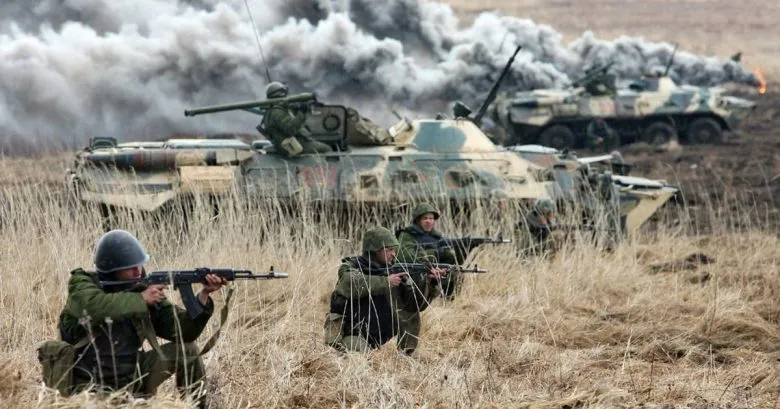
In recent days, Russian forces have sharply increased their assault actions on almost all sections of the front line, utilizing small mechanized and motorized units. Analysts from the Institute for the Study of War (ISW) note that this tactic may be part of a broader strategy of the Russian Federation, but its actual effectiveness raises significant doubts.
This is reported by Finway
New Assaults and Their Outcomes
Over the past 48 hours, Russian forces have conducted four separate mechanized and motorized assaults with units the size of a platoon or smaller across various sections of the front. However, according to ISW’s assessment, these attacks are unlikely to significantly enhance the ongoing spring-summer offensive of Russia in 2026.
“Geolocation video evidence indicates that Russian forces approximately the size of a platoon conducted two mechanized assaults east of Chasiv Yar (northeast of Konstantinivka) on April 18 and 19, as well as a motorized assault using several ‘Ural’ vehicles and at least six motorcycles east of Sviatopetrivka (northwest of Huliaipole) on April 18,” ISW stated.
Additionally, on April 19, another mechanized assault by a platoon-sized unit was recorded near Kucheriv in the Kursk region (southeast of Hlushkovo). ISW found no evidence that these attacks resulted in tactically significant victories — most assaults did not extend beyond the current line of contact.
The Goal of Russia’s New Tactics
ISW estimates that these mechanized and motorized attacks may have been reconnaissance operations aimed at testing the resilience of Ukrainian positions and defensive structures ahead of potential larger-scale offensives. There is a suggestion that Russian forces were attempting to exploit potential tactical advantages near Chasiv Yar, Sviatopetrivka, and Kucheriv.
Analysts believe that Russian units are conducting such attacks across the front to force Ukrainian forces to hold positions even in areas that are currently not priorities for Russia. The main objective for the Russian Federation remains advancing towards the Ukrainian defensive belt in the Donetsk region, particularly on the northern outskirts of Sloviansk.
However, to achieve strategically significant results, Russian forces would need to commit significantly larger forces over a longer period. Ukrainian forces have managed to hold back the Russian offensive in key directions, particularly towards Sloviansk, Vovchansk (Kharkiv region), northwest of Pokrovsk (Donetsk region), and west of Huliaipole towards Orikhiv (Zaporizhzhia region). Notably, there is a mention of the encirclement of Orikhiv along the western bank of the Kakhovka Reservoir.
Strategic Goals and Implications for the Front
ISW emphasizes that Russia is trying to create the appearance of a simultaneous offensive on multiple fronts within the spring-summer campaign of 2026. This is part of an information war aimed at shaping the perception among Ukrainian society and Western partners of the inevitability of a breakthrough in Ukrainian defenses. At the same time, the results of the offensive remain insignificant.
The dispersal of forces by Russia leads to the diversion of resources from key directions, and most attacks on April 18-19 did not affect progress in the Sloviansk area. Only the offensive near Huliaipole occurred in an area where Russian forces reinforced their positions with strategic reserves. ISW concludes that the current tactics do not provide Russia with noticeable operational advantages.
Meanwhile, analysts emphasize that the Kremlin is considering the possibility of conducting a large-scale mobilization to strengthen offensive efforts. Russian forces are ramping up attacks in various directions, seeking to expand control zones, and these actions may be preparations for a new phase of the full-scale war in Ukraine.