

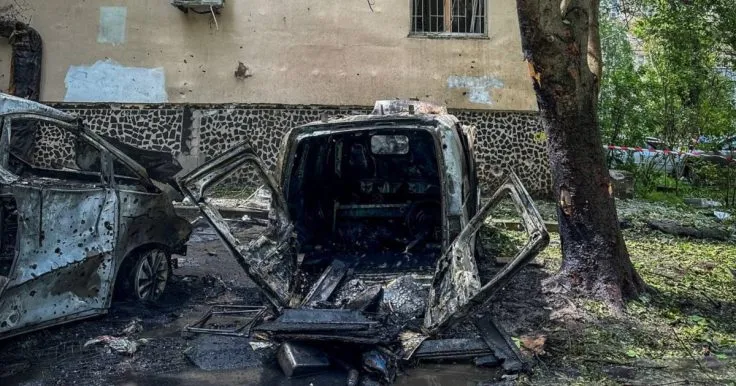
On the night of June 1, Odesa and Kharkiv were targeted in a large-scale drone attack by Russian military forces. As a result of the strikes, residential buildings were damaged, and there were reports of casualties among the civilian population.
This is reported by Finway
Consequences of the attacks in Odesa and Kharkiv
According to the head of the Odesa City Military Administration, Serhiy Lysak, in Odesa, as a result of the enemy drone strike, the first and second floors of a nine-story residential building were partially destroyed, and the facade and balconies were damaged. The fire that broke out after the strike was quickly localized. Additionally, two single-story houses caught fire. In total, four people were injured in the city.
“As a result of the enemy UAV hitting the nine-story building, the first and second floors were partially destroyed. The facade of the building and the balconies were damaged. The fire has been localized… Two single-story houses also caught fire.”
In Kharkiv, according to Mayor Ihor Terekhov, attacks were recorded in the Osnovyansky, Slobidsky, Kyiv, and Holodnohirskiy districts. Three private houses were damaged, a garage cooperative near the apartment buildings was hit, and fires broke out in garages and vehicles. The head of the Kharkiv Regional Military Administration, Oleg Synegubov, reported that at least two people were injured as a result of the shelling in the Osnovyansky district. A five-story residential building, several apartment buildings, five garages, and two other garages were completely destroyed.
Scale of destruction and signs of genocide
Russian forces regularly use various types of weapons — strike drones, missiles, aerial bombs, and multiple launch rocket systems — to attack Ukrainian cities and civilian infrastructure across the country. Ukrainian authorities and international organizations classify these strikes as war crimes of the Russian Federation, emphasizing their targeted nature against the civilian population.
Systematic shelling of critical infrastructure and healthcare facilities, aimed at depriving people of electricity, heat, water supply, communication, and medical assistance, exhibits signs of genocidal actions. Among them are declarations of intent to destroy the Ukrainian people, public calls for repression, persecution of pro-Ukrainian individuals in occupied territories, destruction of the intelligentsia, deportation of children to Russia, and destruction of Ukrainian cultural heritage.
According to the UN Convention on the Prevention and Punishment of the Crime of Genocide, adopted in 1948, participating states are obligated to prevent genocide and punish those guilty of committing such crimes, regardless of whether they occur in wartime or peacetime. The main signs of genocide include mass killings of members of a group, causing them serious bodily harm, creating conditions aimed at destroying the group, obstructing childbirth, forcibly transferring children, and publicly inciting criminal acts.
At the same time, the leadership of Russia denies its army’s involvement in targeted strikes on the civilian infrastructure of Ukrainian cities and villages, despite numerous destructions of hospitals, schools, kindergartens, energy, and water supply facilities, as well as civilian casualties.