

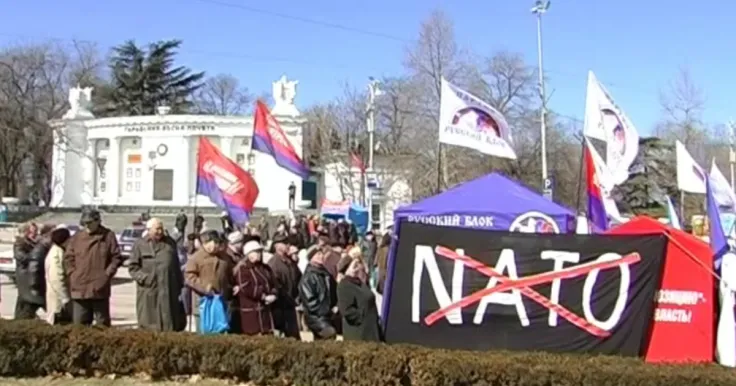
Dmytro Bilotserkovets, a member of the Kyiv City Council and a pro-Ukrainian activist from Sevastopol, stated that the Russian Federation actively sponsored pro-Russian actions in the city during the 2000s. According to him, payments for such events reached thousands of dollars, which is confirmed by financial documents from pro-Russian organizations made publicly available.
This is reported by Finway
Payment for anti-NATO protests in Sevastopol
Bilotserkovets cites an example of one of the events organized during a NATO ship’s visit to Sevastopol as part of joint exercises between Ukraine and the Alliance. According to the activist, pro-Russian activists received 5 thousand dollars for their participation at Grafskaya Pier in the city center near the main wharf. A corresponding entry appeared in the budgets published on local forums during disputes among the organizers themselves.
“For example, in one of these documents, we saw a section regarding the visit of a NATO ship to Sevastopol as part of joint exercises between Ukraine and the Alliance. This military vessel docked at Grafskaya Pier in Nakhimov Square – the main wharf of the city. The budget indicated an amount of 5 thousand dollars for their marginal pro-Russian activists, dressed in T-shirts in the colors of the Russian flag, to board and take photos on the NATO ship in that manner,” recalls the Crimean.
Reaction to the annexation of Crimea and consequences for Ukraine
Commenting on the events of 2014, when the annexation of Crimea and Sevastopol occurred, Bilotserkovets is convinced that a more active stance from Ukraine and Western countries could have stopped the occupation. He believes that the insufficiently decisive reaction of the then US leadership, the State Department, and European leaders was a significant mistake. In his opinion, had stricter measures been taken during that period, further large-scale military actions in Donbas and a full-scale invasion could have been avoided. Bilotserkovets reminds that in 1994, thanks to the decisive actions of then-President of Ukraine Leonid Kuchma, it was possible to stop the crisis known as “Meshkovshchyna.”
He emphasizes that to maintain the territorial integrity of the country, immediate and decisive action was necessary, without waiting for further escalation from Russia. According to him, it was active resistance at crucial moments that could have changed the course of history.