

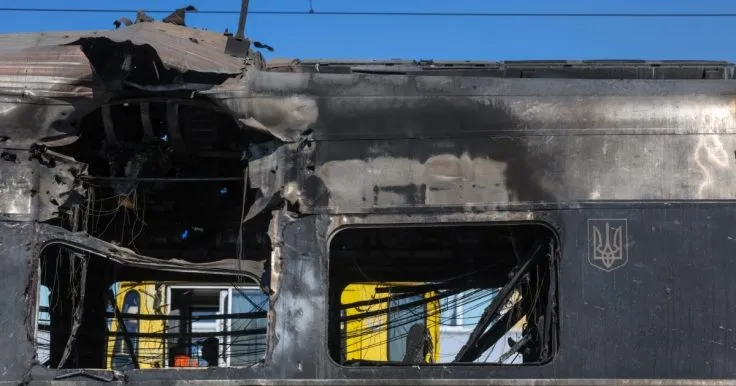
On the night of June 2, Russian military forces carried out a drone attack on a railway train in the Kharkiv region, resulting in injuries to a railway worker. This was reported by the company “Ukrzaliznytsia,” noting that the injured railway worker is receiving the necessary medical assistance promptly.
This is reported by Finway
Consequences of the attack and train movement status
After the strike, emergency medical teams and State Emergency Service rescuers were called to the scene. Railway workers, together with emergency services, are carrying out all necessary work to eliminate the consequences of the attack. According to the carrier, train movement in the Kharkiv region continues, albeit with minor delays.
Scale of shelling across Ukraine
The Ukrainian Air Force reported that on the same night, Russia launched a massive shelling, firing 73 missiles and 656 drones. Ukrainian units managed to shoot down 40 missiles and 602 UAVs. The main focus of the strikes remained Kyiv, but Dnipro, Kharkiv, Zaporizhzhia, Poltava region, and other areas of the country were also attacked.
“The enemy struck a drone attack on a locomotive in Kharkiv region. As a result of the strike, a railway worker was injured, and necessary assistance is being provided.”
The Ministry of Defense of the Russian Federation publicly announced a so-called “massive strike” on defense industry enterprises and fuel and transport infrastructure facilities, claiming that all designated targets were hit.
Russian troops regularly use various types of weapons, including strike drones, missiles, guided bombs, and multiple launch rocket systems, attacking Ukrainian cities and civilian infrastructure across the country.
Ukrainian authorities and international organizations classify these massive strikes as war crimes of the Russian Federation, emphasizing their targeted nature. Shelling of life-support systems — electricity, heating, water supply, medical facilities, and communication — is viewed as a sign of genocidal actions directed against the civilian population.
In response to these accusations, the Russian leadership denies intentional strikes on civilian infrastructure, despite numerous evidence of the destruction of hospitals, schools, kindergartens, energy and water supply facilities, as well as the deaths of civilians due to the actions of the Russian army.