

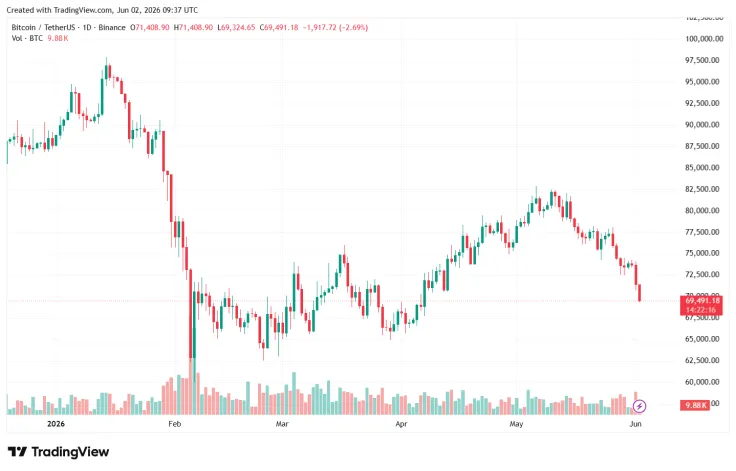
Bitcoin has lost ground and dropped below the $70,000 mark amid rising geopolitical tensions and negative trends in global markets. The sharp decline was triggered by Iran’s announcement to cease negotiations with the United States, which sparked a wave of volatility in financial markets.
This is reported by Finway
Cryptocurrency Decline and Market Dynamics
On June 1, Iran announced its refusal to negotiate with the United States, which immediately affected economic indicators: oil prices rose, while stocks and cryptocurrencies, particularly Bitcoin, experienced significant declines. According to CoinGlass data, the price of Bitcoin is closely linked to the U.S. stock market, causing assets to respond synchronously to macroeconomic and political risks.
At the time of writing, Bitcoin is trading at around $69,500. Over the past day, its price has decreased by 2.6%, and over the week, by more than 10%. Similarly, Ethereum and other cryptocurrencies also ended May in the red, indicating the global nature of the correction.

Most altcoins are also showing negative dynamics, with their capitalization decreasing on daily charts. The daily liquidation volume in the cryptocurrency market exceeded $800 million, with more than half of this amount consisting of Bitcoin positions, primarily long ones, indicating that traders were expecting a rise.

The Fear and Greed Index has moved into the “orange” zone, indicating prevailing investor sentiment towards selling assets. If the index continues to decline into the “red” zone, further panic selling can be expected.


Key Influencing Factors and Future Prospects
According to analysts, the current decline in Bitcoin and other digital assets is due to a combination of external and internal factors. Among them are significant Bitcoin sales by Strategy, the largest corporate holder of this cryptocurrency, as well as the cessation of dialogue between Iran and the U.S. President Donald Trump has not yet commented on the Iranian side’s decision but noted on social media the importance of U.S. victories in the Middle East.
Rising oil prices and a simultaneous decline in the value of S&P 500 futures (by 0.11%) demonstrate the global impact of political uncertainty on various market segments. The correlation between Bitcoin and U.S. stocks, according to CoinGlass, is 0.738, indicating a significant dependence of the cryptocurrency on the overall state of the stock market.

“The closer the indicator is to 1, the stronger the relationship between the assets.”
Additional pressure on the market may come from a large number of Bitcoins being withdrawn from Mt. Gox accounts. If they are sold without significant demand from major players, the price of Bitcoin could decrease further.
At the same time, some experts remain cautiously optimistic. Michael van de Poppe, founder of MN Fund and MN Capital, believes that a deep correction is not expected in June: Bitcoin is likely to test levels below $70,000, but after that, it may find support and reverse the trend.