

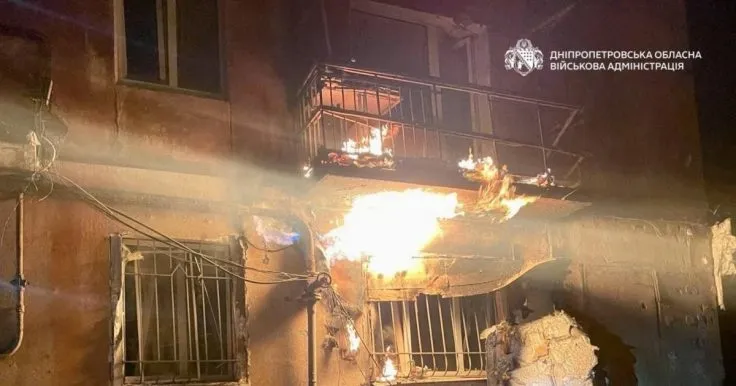
On the night of May 7, the Russian army carried out another missile strike on Dnipro. This was reported by the head of the regional military administration, Oleksandr Hanzha. As a result of the attack, two people were injured: a 21-year-old pregnant woman and a 45-year-old man. Medical personnel provided them with the necessary assistance directly at the scene.
This is reported by Finway
“This is a 21-year-old pregnant woman and a 45-year-old man. Both received medical assistance on site.”
Damage in the city and ongoing threat
Prior to this, there was information about one injured person and a fire in an apartment of a five-story building due to the strike by the Russian Federation. The shockwave damaged several neighboring houses and cars that were nearby. Such shelling has already become regular: the Russian Federation uses a wide arsenal of weapons — from strike drones to various types of missiles and aerial bombs — to attack Ukrainian cities and civilian infrastructure across all regions of the country.
Systematic nature of aggression and qualification of crimes
The Ukrainian authorities and international organizations classify such strikes as war crimes, pointing to their targeted nature. In particular, shelling of critical infrastructure, such as energy, water supply, and healthcare facilities, aims to deprive the population of essential resources for survival. This, according to lawyers, genocide researchers, and human rights defenders, is a sign of genocidal actions by Russia — especially considering the systematic statements by high-ranking officials of the Russian Federation about the intent to destroy Ukrainians as a nation, as well as targeted attacks on the identity, culture, and future of the Ukrainian people.
Among such actions are public calls for the destruction of Ukrainians, targeted strikes on civilian infrastructure, persecution of people with pro-Ukrainian views in occupied territories, extermination of the intelligentsia, deportation of children to Russia, and attempts to destroy national identity through education and culture.
The Convention on the Prevention and Punishment of the Crime of Genocide, adopted by the UN General Assembly in 1948, obliges 149 participating countries to prevent and punish genocide in both peacetime and wartime. Genocide is considered to be actions aimed at the partial or total destruction of a national, ethnic, racial, or religious group. Signs of genocide include killings, causing serious bodily harm, creating living conditions that are unbearable, obstructing childbirth, forcibly transferring children, and inciting such actions.
Despite the obvious evidence, the leadership of the Russian Federation continues to deny the facts of targeted shelling of civilian infrastructure, resulting in the deaths of civilians, and the destruction of hospitals, educational institutions, energy facilities, and water supply systems throughout Ukraine.