

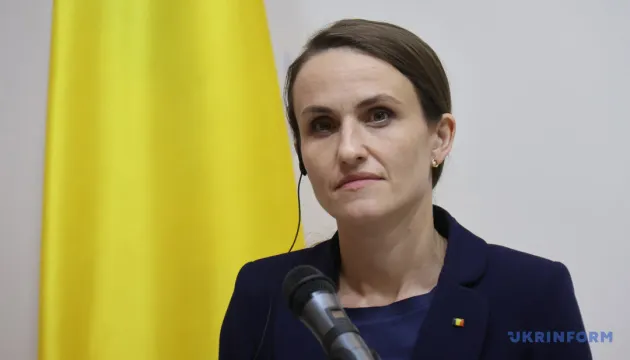
Romanian Foreign Minister Oana Cărbunaru has urged the European Union to intensify pressure on Russia, especially in light of preparations for the twentieth sanctions package. This call comes in response to the additional profits that Russia is gaining from the export of oil products amid escalating tensions in the Middle East.
This is reported by Finway
Romania’s Position on Supporting Ukraine and Sanctions
Oana Cărbunaru emphasized the importance of the swift disbursement of a €90 billion loan to support Ukraine. She noted that the EU’s decision to extend the existing sanctions against Russia for six months is a positive step, but it is insufficient given that Russia is finding new sources of income.
“Regarding the need to support Ukraine, Romania’s position is very clear: the €90 billion loan must be paid out quickly. It is also good that we have collectively decided in the EU to extend the current sanctions against Russia for six months. However, more needs to be done to increase pressure, especially considering that Russia now has an additional source of income—oil revenues that were not at this level before. This means that at the EU level, from Romania’s perspective, we must continue to strengthen pressure in the context of preparing the 20th sanctions package,” Cărbunaru stressed.
Environmental Consequences of Attacks and Government Response
The minister also drew attention to Russia’s recent attack on a Ukrainian power plant, which resulted in an environmental disaster on the Dniester River. The pollution of the river has caused a crisis that has also affected Moldova. She noted the effective response of the Moldovan government and emphasized the possibility of providing assistance through the European Union’s Civil Protection Mechanism.
Moldovan President Maia Sandu stated that the country’s water supply is threatened due to pollutants entering the Dniester following Russia’s attack on the Novodnistrovsk Hydroelectric Power Station. After the missile and drone attack on March 10, patches of technical oils were found downstream near the village of Naslavcha in Moldova.
Ukrainian President Volodymyr Zelensky emphasized that Russia’s revenues from oil sales will be directed towards financing the war, particularly for the production of drones that could reach the Middle East and be used against the United States and its allies.