

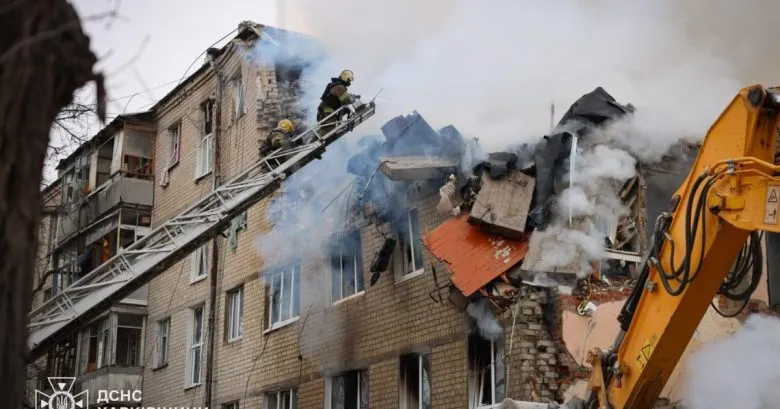
The number of casualties from yet another Russian shelling of Kharkiv has risen to at least 11 people, including two children – a 13-year-old girl and a 9-year-old boy. This was reported by local authorities, the State Emergency Service, and the Kharkiv Regional Prosecutor’s Office. According to the latest information, another 16 people have sustained injuries of varying severity.
This is reported by Finway
Search and rescue operations in Kharkiv continue
Active search and rescue efforts and firefighting caused by the shelling are ongoing at the site of the tragedy. The Mayor of Kharkiv, Ihor Terekhov, announced the discovery of another victim under the rubble of the collapsed five-story building, which led to an update in the casualty count. As of 14:10, according to the prosecutor’s office, the death of 11 people has been confirmed, including two children.
“The number of dead in Kharkiv has risen to 10 people, including 2 children – a 13-year-old girl and a 9-year-old boy. Another 16 people are injured,” the State Emergency Service reported.
Scale of attacks and signs of genocide
According to the Air Force, in a new wave of attacks, the Russian army directed 480 drones and 29 missiles at Ukraine, but air defense forces shot down 453 drones and 19 missiles. The main targets of the strikes remain Kyiv, Kharkiv, Zhytomyr region, Khmelnytskyi region, and Chernivtsi region.
Russian troops systematically attack Ukrainian cities using various types of weapons, including strike drones, missiles, aerial bombs, and multiple launch rocket systems. These strikes are aimed at civilian infrastructure, residential areas, energy supply systems, and healthcare facilities, depriving the population of basic living conditions.
Ukrainian authorities and international human rights organizations regard such actions as war crimes and signs of genocide. In particular, shelling of life-support systems, hospitals, energy facilities, and the mass persecution of Ukrainians in occupied territories are recorded as part of a deliberate policy to destroy the Ukrainian people.
The Russian leadership regularly denies shelling civilian infrastructure, but public statements from Russian officials indicate the presence of an ideology aimed at destroying Ukrainian identity and people. The deportation of children, persecution of pro-Ukrainian activists, and the destruction of Ukrainian culture and education in occupied territories are also seen by experts as manifestations of genocidal actions.
The UN Convention on the Prevention and Punishment of the Crime of Genocide, adopted in 1948, defines genocide as actions aimed at the partial or total destruction of a national, ethnic, racial, or religious group. Among the signs of genocide are mass killings, deliberately creating conditions for the destruction of a group, preventing childbirth, and forcibly transferring children to another group, as well as public calls for such actions.
All countries that are parties to this Convention, currently numbering 149, are obligated to prevent acts of genocide and to punish them in both wartime and peacetime.