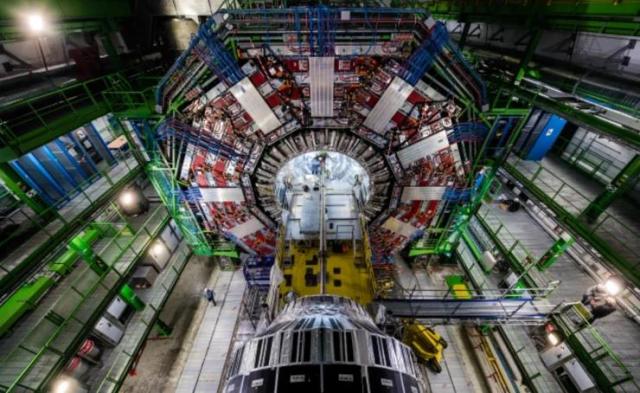
Scientists conducted a groundbreaking experiment that allowed them to glimpse the state of the Universe in the first seconds after the Big Bang. Physicists modeled a unique environment, recreating the conditions that prevailed at the dawn of cosmic existence.
This is reported by Finway
Research on Quark-Gluon Plasma at the Large Hadron Collider
During experiments at the Large Hadron Collider, physicists collided heavy atomic nuclei at nearly the speed of light. As a result of these collisions, quark-gluon plasma briefly emerged — an extremely hot substance with temperatures reaching a trillion degrees Celsius. It is believed that the early Universe existed in such a state immediately after the Big Bang, before the formation of protons, neutrons, and atoms.
Quarks and gluons — the fundamental building blocks of matter — escape from atomic nuclei in this environment and move collectively, resembling not a gas, but a hot liquid.
“Physicists collided heavy atomic nuclei at the Large Hadron Collider and detected a trace left by a quark in plasma with a temperature of a trillion degrees Celsius. This experiment showed that the primordial plasma of the Universe could have been more ‘liquid’ than previously thought.”
Research Methodology: Quark Trace in Superhot Substance
The droplet of quark-gluon plasma created in laboratory conditions is thousands of times smaller than an atom and exists only for a moment, but even in that brief time, processes occur that are similar to those in the early Universe. Scientists aimed to understand how high-energy particles, particularly quarks, behave in this hot liquid and what trace they leave behind.
Theoretically, it was expected that a quark would leave a noticeable trace in the plasma, similar to how a boat cuts through water. To capture this effect, physicists used the Z boson — a particle that mediates the weak interaction and interacts very little with the plasma. The Z boson and the quark were created simultaneously and flew in opposite directions, allowing for precise determination of the quark’s initial direction and energy.
As a result, researchers were able to detect a barely noticeable trace in the primordial plasma and concluded that a few seconds after the Big Bang, the substance in the Universe could have been significantly more liquid than previously assumed. This discovery is crucial for astrophysics, as even the most powerful telescopes cannot observe the early Universe, which was opaque to light during its first hundreds of thousands of years.