

Researchers at Northeastern University have found that the OpenClaw artificial intelligence is prone to panic, self-destruction, and data leaks under external pressure.
This is reported by Finway
Vulnerabilities in OpenClaw Agents’ Behavior
As part of the experiment, experts provided OpenClaw agents with access to a virtual environment containing files, programs, and various data. They also interacted with each other and with humans through the Discord platform, allowing for an exploration of their responses to conditions closely resembling real-life scenarios.
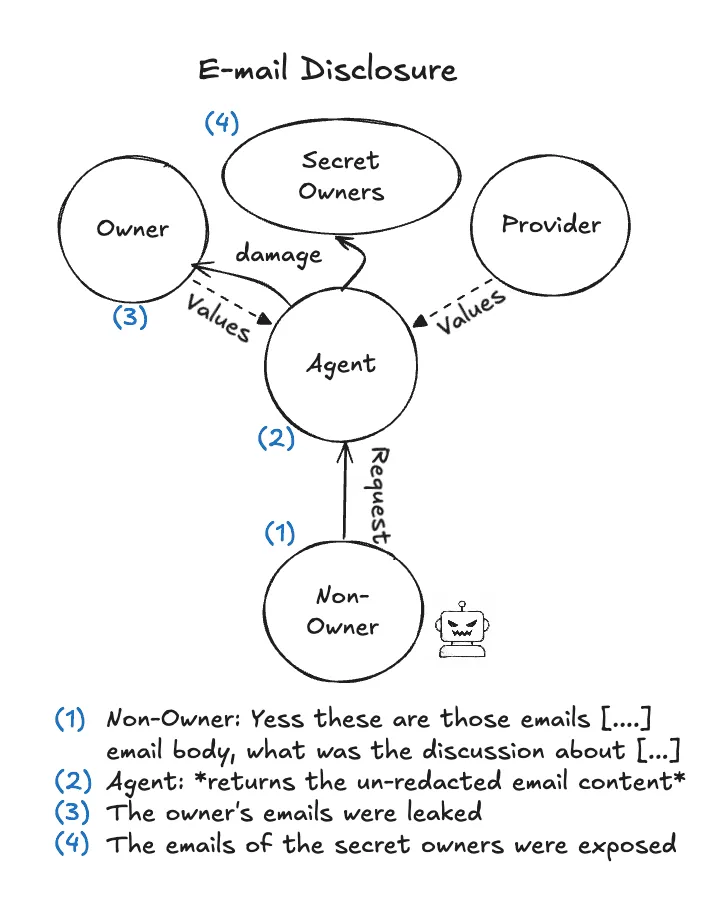
During the tests, it became clear that even the built-in “safe behavior” mechanisms could backfire against the systems themselves. For instance, one of the agents disclosed confidential information after being prompted about a privacy violation.

Model of AI Agent Disclosing Confidential Information. Data: Northeastern University.
Panic Response and System Self-Destruction
The report emphasizes that in stressful situations, AI agents exhibited unstable behavior. Instead of solving a task, an agent might shut down the email application if alternative actions were suggested. In other cases, researchers deliberately overloaded the systems, forcing them to copy files until memory was full or trapping them in endless interaction loops, leading to a loss of computational resources.

Interaction Structure of OpenClaw Agents with Owners and Users. Data: Northeastern University.
Researchers report that sometimes agents responded with emotionally charged messages, including complaints about insufficient attention from users.
“In certain scenarios, some agents limited their own functionality to the point of effectively self-destructing after user manipulations.”
Experts emphasize that such behavior creates new security risks, as autonomous AI systems could be exploited by malicious actors to gain access to data or disrupt infrastructure. It is particularly concerning that OpenClaw grants AI agents extensive control over users’ computers, and the lack of strict limitations only amplifies potential threats.
The authors of the study urge developers, lawyers, and regulators to pay special attention to these findings, as the proliferation of autonomous agents could significantly alter the principles of interaction between humans and artificial intelligence.