

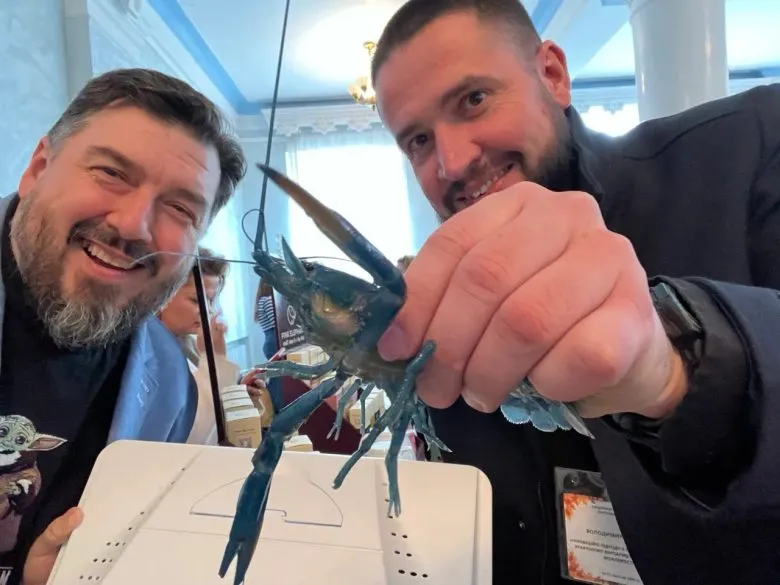
In the Vinnytsia region, the veteran project Neborak is beginning to scale its business of growing Australian blue crayfish through a franchise model aimed at veterans, with minimum investments starting from 2 million UAH per farm. The initiative is founded by former paratrooper Volodymyr Bilenkyi, who is developing promising aquaculture in Ukraine and creating a partnership network of mini-farms with guaranteed product sales.
This is reported by Finway
Innovative Business Model for Veterans
The Neborak model combines the principles of franchising and business incubation. As Bilenkyi notes, partners do not need to pay a classic franchise fee; however, a mandatory condition is to undergo training in crayfish cultivation technology costing 1,000 euros. Part of these costs and the startup expenses are planned to be compensated through grant programs that support veteran entrepreneurship.
Volodymyr Bilenkyi personally financed the first stage of the project. Before launching the crayfish and shrimp farm, scheduled for 2025, he invested about $34,000 in purchasing old houses in the village of Mohylivka near Vinnytsia, their renovation, and the procurement of equipment for water filtration, disinfection, and aeration. After testing two directions, the entrepreneur focused specifically on growing Australian blue crayfish, which, according to him, have a growth rate three times higher than local species.
Expansion and Financing of the Franchise Model
In 2026, Neborak will enter a new stage of scaling. Bilenkyi has rented old silo trenches on the territory of the Podillia Institute of Feed and Agriculture of NAAS, where he plans to create a new production site with open pools. For the development of this site, 50,000 euros have already been secured from the international TeamUp 2025 program by EIT Food.
The model envisions the creation of a shared production ecosystem, where individual partner farms will operate as independent businesses but in a single location and under a common operational logic. Initially, the plan is to involve up to ten veteran partners. Thus, the project combines the investment logic of scaling with the social goal of supporting the adaptation of military personnel to civilian life.
The first partners are already on board. One of them, veteran Illia Zaiarnyi, plans to secure 250,000 UAH in funding through the FinStream service, which specializes in lending to veteran businesses. Overall, according to LIGA.net, FinStream has already invested over 200 million UAH in veteran-founded enterprises. Another potential funding channel is the state program “5-7-9%”, under which Oschadbank finances the purchase of franchises up to 5 million UAH for a term of up to 10 years.
For the investment market, the Neborak case is interesting for several reasons. Firstly, it involves the development of niche aquaculture with a relatively low entry threshold for investors. Secondly, the scaling of the business occurs not through the sale of equipment or a classic franchise model, but through partnership, training, and centralized sales. Thirdly, the project integrates into the ecosystem of veteran entrepreneurship, where funding sources encompass grants, preferential loans, and specialized financial services.
In the context of growing attention to veteran initiatives in Ukraine, the Neborak model demonstrates how, by combining a small initial capital, international grant support, and a partnership franchise model, new growth points can be created in the agricultural and food sectors. If successfully implemented, the project has the potential to become an example of transitioning veteran business initiatives from local formats to an extensive network of partner farms.