

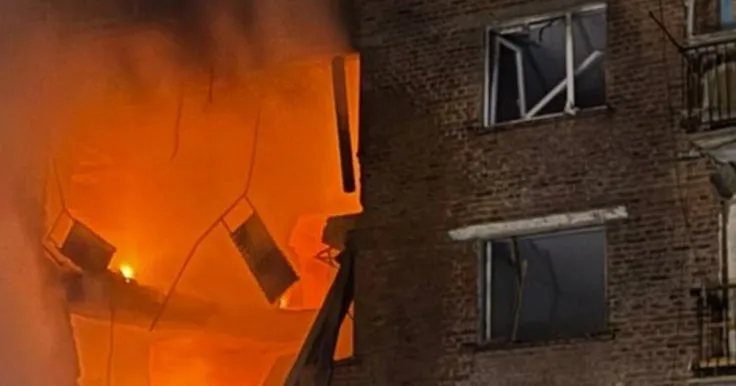
In the city of Konotop in the Sumy region, as a result of a night attack by Russian drones that occurred on May 20, part of a five-story residential building was damaged. This was reported by the city mayor Artem Semenikhin, noting that people may still be trapped under the rubble. Search and rescue operations are ongoing, and the exact number of victims is being clarified.
This is reported by Finway
“There are many injured. The exact number is currently unknown. It is not yet known about any casualties,” Semenikhin wrote on Telegram, adding that a rescue operation is underway in the high-rise building where three floors collapsed as a result of a strike by a Shahed drone.
According to the mayor, the strike led to the collapse of three floors of the building and caused significant damage to other city infrastructure. “Windows were shattered in the hospital… Numerous windows and doors were broken in administrative buildings, homes, and apartments… Our museum is no more,” the city leader noted.
Rescue efforts and consequences of the attack
The head of the Sumy Regional Military Administration, Oleg Grygorov, confirmed that at least six people are known to be injured in Konotop, but this information is constantly being updated as rescue operations continue. According to him, during the night, Russian drones targeted residential areas not only in Konotop but also in the Shostka community.
In addition to the damaged high-rise, windows and doors were shattered in many government institutions, residential buildings, and hospitals. Currently, the city is organizing the evacuation of residents from the destroyed and adjacent buildings, while municipal services are eliminating the consequences of the attack.
Targeted attacks by Russia as war crimes
Russian forces continue to systematically attack Ukrainian cities and civilian infrastructure using various types of weapons: strike drones, missiles, guided aerial bombs, and multiple launch rocket systems. Ukrainian authorities and international organizations classify such actions as war crimes of the Russian Federation, emphasizing their targeted nature against the civilian population.
Shelling of the population’s life support systems and medical facilities with the aim of depriving people of basic living conditions (electricity, heating, water, communication, medical assistance) has the characteristics of genocidal actions. Experts, human rights defenders, and genocide researchers emphasize that Russia is committing all types of crimes against Ukrainian citizens that fall under the definition of genocide: from targeted shelling to the deportation of children and the destruction of cultural heritage.
The Convention on the Prevention and Punishment of the Crime of Genocide, adopted by the UN in 1948, obliges 149 participating countries to prevent acts of genocide and punish them regardless of whether they occur during war or in peacetime. According to the provisions of the document, genocide is recognized as actions committed with the intent to destroy, in whole or in part, a particular national, ethnic, racial, or religious group. Among the signs of genocide are killings, causing serious bodily harm, creating unbearable living conditions, obstructing childbirth, forcibly transferring children, and public calls for such actions.
The Russian leadership rejects accusations of targeted strikes on civilian infrastructure, although the facts of mass destruction of hospitals, schools, energy facilities, and housing in Ukraine testify to the opposite.