

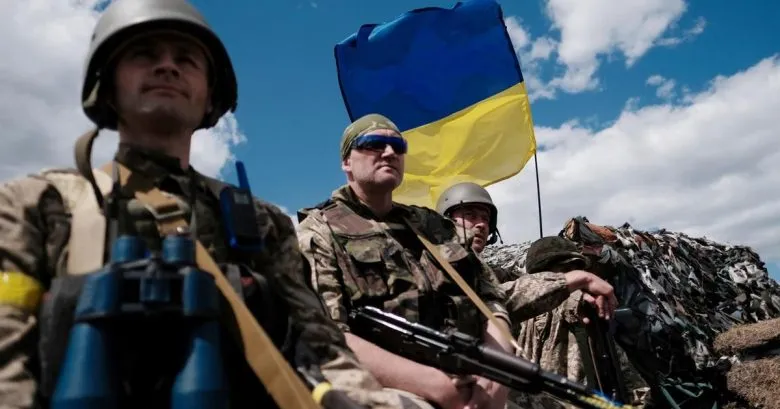
Recent days have demonstrated important trends in the development of the war: Ukraine is no longer just defending itself but is actively influencing the course of hostilities, shaping new approaches to warfare through technology, flexibility, and rapid learning.
This is reported by Finway
Successes of Ukrainian Air Defense and Innovations on the Front
According to The Times, Ukraine’s modern air defense system is considered one of the most sophisticated in the world. Ukrainian forces have managed to integrate Soviet and Western systems into a single effective command structure. Throughout the years of war, approximately 140,000 aerial targets have been destroyed, including over 44,000 Shahed drones. Senior researcher at RUSI, Justin Bronk, notes that Ukraine’s experience in air defense has become a model for other countries and cannot be ignored, as Ukraine has transformed into one of the world’s centers of competence in air defense command.
“Ukraine no longer just needs a system; it exports its own combat experience.”
On land, Russia continues to employ tactics of mass assaults, utilizing a significant number of troops, armored vehicles, and motor transport. However, increasingly, such attacks end with substantial losses instead of breakthroughs. For example, during the offensive in the Lyman-Borova direction, according to Ukrainian military sources, Russia deployed over 500 troops and more than 28 units of armored vehicles, but the attack was thwarted even at the preparation stage. As a result, Russia lost dozens of units of equipment, including tanks, BMPs, the TOC-1A system, and artillery.
These events indicate that in modern warfare, the victor is the one who analyzes the opponent’s actions more quickly and adapts to changes on the battlefield.
Drones and Systemic Change in the Nature of War
The use of drones has become a key factor in changes to military strategy. Drones are no longer just auxiliary tools but the foundation of modern combat operations. The increasing losses of Russian infantry from strikes by Ukrainian UAVs exceed the rate of personnel replenishment, altering the balance of power on the front. Additionally, targeted strikes on oil terminals, UAV warehouses, radar stations, and Russian air defense systems undermine its ability to continue the war in the usual format, forcing Ukraine to counter not only the military directly but the entire supply chain of the opponent.
In an article by Diana Francis for the Kyiv Post and Atlantic Council, it is aptly noted that Ukraine is becoming a state of military technologies, where combat experience stimulates the emergence of innovations. Experts estimate that the war has transformed Ukraine into a “laboratory of new warfare.”
At the same time, changes are occurring in Russia: even among representatives of the systemic power, there is a growing awareness of the impossibility of achieving the goals declared by the Kremlin. This does not mean the inevitable collapse of Russia, but indicates a pragmatic reassessment of the cost of war within the country.
In Europe, there is an increasing focus on security and counterintelligence activities. Following reports of possible leaks from Hungarian officials in favor of Russia, the EU has limited Hungary’s participation in sensitive discussions. Polish Prime Minister Donald Tusk confirmed that such concerns had existed previously.
NATO and the U.S., despite political discussions, continue to provide Ukraine with crucial intelligence and military support, which remains a key factor in countering Russia.
In conclusion, today Russia is betting on quantity, while Ukraine is focusing on speed of adaptation and technological breakthroughs. The main resource for Ukraine is not only resilience but primarily the experience of war, which is being implemented into practical solutions, a new military doctrine, and modern technologies. This complex gives Ukraine a significant advantage over the opponent and determines the course of the war in 2026.