

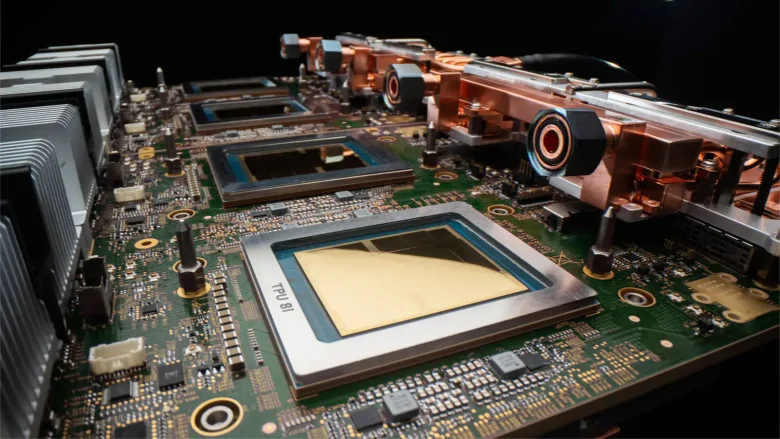
Google has announced a new line of artificial intelligence chips – the eighth generation TPU, which is set to provide a significant breakthrough in training speed and efficiency of AI models. The architecture of the new chips is divided into two directions: TPU 8t is focused on model training, while TPU 8i is aimed at their further use in production environments.
This is reported by Finway
Power and Scalability of TPU 8
According to Google, these chips allow for a threefold acceleration of the model training process compared to the previous generation. Additionally, the new series demonstrates up to 80% better performance per dollar, making AI training more accessible for companies of various sizes. The updated infrastructure enables the integration of over a million TPUs into a single cluster, opening new horizons for large-scale computing while simultaneously reducing energy consumption.

“The company emphasized that the new solutions are aimed at optimizing various stages of working with AI — from training to processing user requests.”
Google’s Development and Partnership Strategy
Google continues to develop its own technologies but does not shy away from partnerships with leading industry players. In particular, the company continues to actively collaborate with Nvidia, combining its own developments with the technologies of this manufacturer. In 2026, Google’s cloud platform will gain access to the new Vera Rubin chip, indicating the continuation of a hybrid strategy in the development of AI infrastructure.
Additionally, reports indicate a joint effort between Google and Nvidia to develop the Falcon networking technology, which aims to enhance the efficiency of interaction among computing systems in modern data centers. Experts believe that the launch of the eighth generation TPU reflects Google’s desire to reduce dependence on external suppliers and strengthen its position in the cloud computing market.
Analysts note that Google, Microsoft, and Amazon are actively investing in the creation of their own AI chips, which could significantly alter the balance of power in the field of high-performance computing and artificial intelligence in the future.