

The Financial Stability Board (FSB) has released its report for 2025, which specifically addresses the risks associated with the implementation of stablecoins in developing and transitional economies (EMDE).
This is reported by Finway
Main Risks to Financial Stability
The FSB emphasizes that stablecoins can negatively impact the stability of financial flows, reduce trust in national currencies, and undermine the effectiveness of monetary policy. According to the report’s findings, such crypto-assets pose additional threats to:
- financial transparency and integrity;
- the fight against illegal financial activities;
- the protection of personal data;
- cybersecurity;
- the protection of consumer and investor rights;
- market integrity;
- budgetary and macroeconomic stability.
These risks are particularly relevant for countries with limited resources and institutional capacities, as stablecoins are rapidly spreading due to low transaction costs and their cross-border nature.
Historic Peak in Stablecoin Transactions
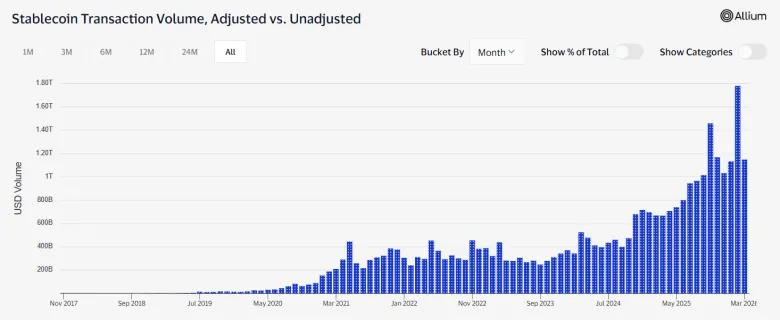
The FSB report relies on analytics from Visa’s dashboard, which shows an increase in stablecoin transaction volumes in 2025. In February 2026, this figure reached a historic monthly high of $1.78 trillion, indicating the rapid popularization of this class of digital assets.

“The FSB noted that such assets could destabilize financial flows, decrease the use of national currencies, and consequently, the effectiveness of monetary policy.”
At the same time, as highlighted in the report, the actual implementation of stablecoins and other crypto-assets in the broader economy remains at a low level.
The FSB is funded by the Bank for International Settlements (BIS), which also published a separate report in June 2025 regarding the risks of stablecoins to the global financial system.