

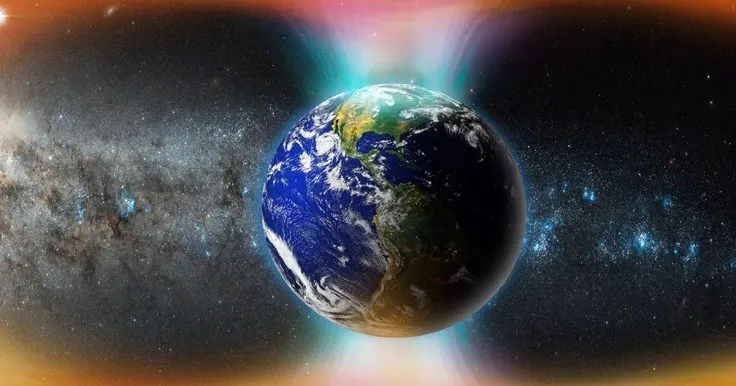
A group of researchers from the University of Southern California has found that the current in the Pacific Ocean has unexpectedly changed direction, resulting from changes in Earth’s outer core. The scale of this phenomenon has been a true revelation for scientists, who did not anticipate such significant shifts in the planet’s deep processes.
This is reported by Finway
Researchers’ Discovery and New Data on Earth’s Core
As part of a study that lasted from 1997 to 2025, scientists combined satellite and ground observations to track the behavior of the outer core at depths of over 5,100 kilometers beneath the Earth’s surface. Despite technological advancements, the core of our planet remains poorly understood due to its inaccessibility, as the deepest human-drilled well reaches only 12,263 meters.
Modern science allows for the acquisition of information about the core through the analysis of seismic waves and magnetic field lines that form under extreme conditions beneath the Earth’s surface. As a result, scientists are making new discoveries regarding the internal structure and dynamics of the planet. For instance, it has previously been established that the inner core changes its rotation directions relative to the surface, oscillating at least once a year by approximately one-tenth of a degree.
According to Professor John Vidale from the University of Southern California, “the inner core of the Earth is not stationary — in fact, it moves beneath our feet, and it seems to shift back and forth by a couple of kilometers every six years.”
Changes in Currents and Their Connection to Deep Processes
Further analyses have shown that since 2010, the rotation of the core behaves differently than before, and the behavior of the liquid iron alloy in the outer core has also changed. Historically, the flow from the core to the Earth’s surface was westward, which ensured the stability of the magnetic field. However, in 2010, a team of researchers recorded a change in the flow direction in the equatorial part of the Pacific Ocean — from west to east. Recent data indicates that since 2020, this eastern flow has been gradually weakening.
Experts suggest that these transformations may be the result of events in the deeper layers of the core that occurred in 2010. The timing coincidence between the change in flow and the change in the behavior of the inner core indicates a connection between these processes. Scientists are using geodetic and seismological data for further analysis, which will help to better understand the relationships between the planet’s deep processes and changes in the currents beneath the Pacific Ocean.