

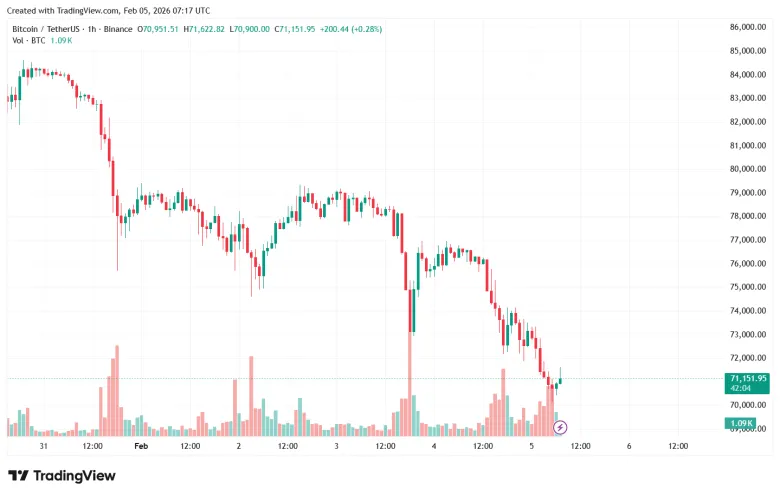
On the morning of February 5, 2026, the Bitcoin exchange rate recorded a sharp decline, temporarily dropping to $70,145 on the TradingView platform. On some exchanges, including Bitstamp, the price fell even further — to $69,101. Subsequently, Bitcoin partially regained lost ground and was trading at $71,152. The daily decline reached 2.6%, while the weekly trend shows a drop of 20.2%.
This is reported by Finway
Record Liquidations and Deep Correction of Altcoins
In the last 24 hours, the volume of liquidations of futures positions in the cryptocurrency market exceeded $853 million, according to CoinGlass data. Most of the forcibly closed positions were long positions. The total number of traders who experienced liquidations amounted to 175,713 individuals. The majority of losses were attributed to Bitcoin and Ethereum — over $600 million.

The drop in Bitcoin triggered a wave of corrections among other major crypto assets. Altcoins lost even more in value: a decline of 7–10% was recorded for most of them.

Pessimistic Sentiments in the Market and Possible Reasons for the Crash
The Fear and Greed Index, which reflects the prevailing sentiments of participants in the crypto asset market, fell to 12 points. This is the lowest level since mid-December 2025. Against this backdrop, pessimistic expectations regarding future dynamics prevail in the community, and some traders believe that breaking below the $70,000 level could lead to a prolonged bearish phase in the market.
“Users believe that if the price drops below $70,000, losing this support level, the market will likely enter a bearish phase”.

Among the key factors for the decline, experts cite the correlation with the stock market, where a sell-off of technology stocks was observed. In particular, the South Korean Kospi index fell by nearly 4%, Nikkei 225 by 0.9%, Samsung Electronics shares dropped by 5.9%, SK Hynix by 6.7%, and the S&P 500 by 0.5%.
Additional pressure on the cryptocurrency market is caused by the potential nomination of Kevin Warsh as the next head of the U.S. Federal Reserve, known for his strict monetary policy.