

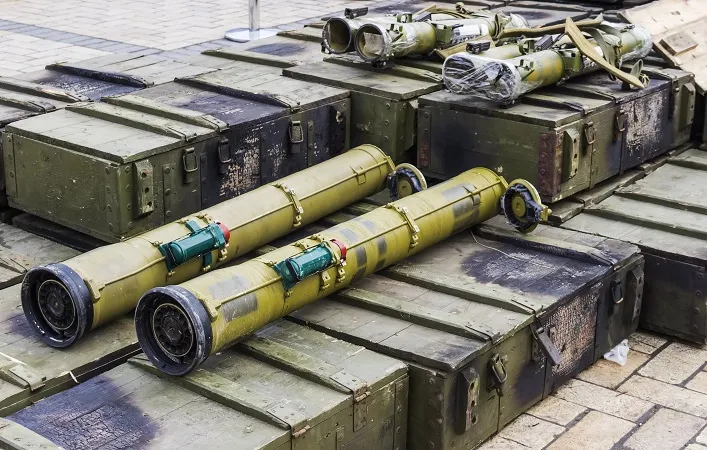
The export of military products from the Russian Federation, which before the full-scale war against Ukraine brought the country about $14 billion annually, has decreased by 50% compared to 2022. This statement was made by Sergey Chemezov, the CEO of the state corporation “Rostec.” In his opinion, the main volume of production is now focused on meeting the needs of the Russian occupying army, and the international sanctions imposed have significantly complicated the activities of both the civilian and defense divisions of the company.
This is reported by Finway
“The export of Russian weapons, which before the invasion of Ukraine brought the country’s economy about $14 billion annually, has fallen by 50% compared to 2022, said Sergey Chemezov, CEO of the state corporation ‘Rostec.'”
First Export Shipment of the Su-57 Fighter
Against the backdrop of the overall decline in Russian arms exports, the Russian authorities announced the first export shipment of the fifth-generation Su-57 fighter. This is the first case where such aircraft have been supplied for the needs of the armed forces of another state — likely Algeria. According to experts’ estimates, Russia has produced about twenty such aircraft.
Russia’s Budget: Record Spending on Defense and the Military
At the same time, the State Duma of Russia has approved a new package of budget bills that include tax increases, record spending on the army and security forces, as well as cuts in funding for key healthcare programs. The largest share of the budget, approximately 30%, is allocated to the “national defense” item — amounting to 12.9 trillion rubles in 2026. Over the next few years, spending will continue to rise: in 2027 it will reach 13.57 trillion, and in 2028 it will amount to 13.05 trillion rubles. In total, over three years, the Russian budget will spend 39.5 trillion rubles on the military and arms procurement, equivalent to $487 billion.
Additionally, spending to support the national economy will increase by 414 billion rubles, totaling 4.77 trillion, while social support for the population will rise by 611 billion, reaching 7.1 trillion rubles. Healthcare spending will effectively remain at the same level: in 2026 it will amount to 1.87 trillion rubles compared to 1.86 trillion this year.