


Archaeologists have reported the discovery of a rare rock painting approximately 5,000 years old, illustrating one of the earliest military conquests in ancient Egypt.
This is reported by Finway
Details of the Archaeological Find in the Sinai Desert
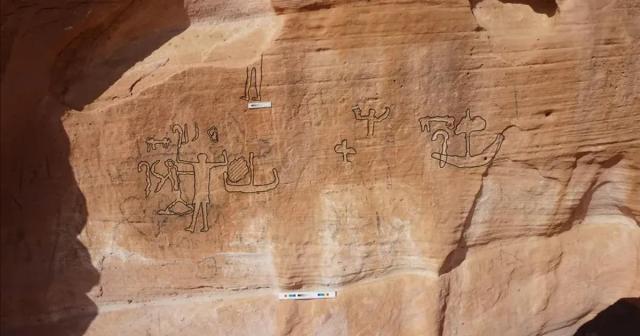
During a research expedition in 2025, Egyptian archaeologist Mustafa Nour El-Din from the Aswan Inspectorate of the Ministry of Antiquities discovered a unique image on a stone panel in the Sinai Desert. The painting depicts a man with raised arms, symbolizing triumph, alongside another man on his knees with an arrow in his chest and his hands bound behind his back. Nearby, a boat is illustrated, and an inscription on the panel refers to the god Min, calling him “the ruler of the copper region.” Researchers associate the boat with the Egyptian ruler, the victor with the deity Min, and the defeated with the local inhabitants of Sinai.
Historical Context and Significance of the Discovery
Similar rock paintings dating back around 5,000 years have previously been found on the Sinai Peninsula. Scholars are convinced that these artifacts confirm the establishment of control by the ancient Egyptian state over the region during that period. The reason for the Egyptians’ expansion into southwestern Sinai was the desire to gain access to mineral resources, particularly copper and turquoise deposits.
“The stone panel depicts a man with raised arms — a symbol of triumph, while another man kneels beside him with an arrow in his chest and his hands bound behind his back. The composition also includes a boat and an inscription that refers to the god Min as ‘the ruler of the copper region.’ Researchers believe that the boat symbolizes the Egyptian ruler, the triumphant figure is associated with Min, and the slain figure represents the local inhabitants of Sinai.”
Adding to the intrigue is the presence of a faded inscription near the image of the boat. There is speculation that it may have contained the name of the Egyptian ruler, but it was deliberately destroyed. The reason for this remains unknown, although there have been precedents in Egyptian history for the removal of pharaohs’ names after a change of power.
Scientists do not rule out the possibility that other similar paintings may be nearby, so future archaeological expeditions are planned to be conducted on a larger scale.