

Anthropic officially introduced Claude Opus 4.8 — an updated version of its flagship artificial intelligence model. Developers emphasize that it has become more accurate in detecting and recognizing its own mistakes while coding, and has achieved higher results in key benchmarks compared to its predecessors.
This is reported by Finway
New capabilities and test results
Claude Opus 4.8 replaces version 4.7, which was released in April 2026. According to the company, the new version demonstrates increased speed and efficiency in various tests, while maintaining the previous pricing policy — $5 per 1 million input tokens and $25 per 1 million output tokens.

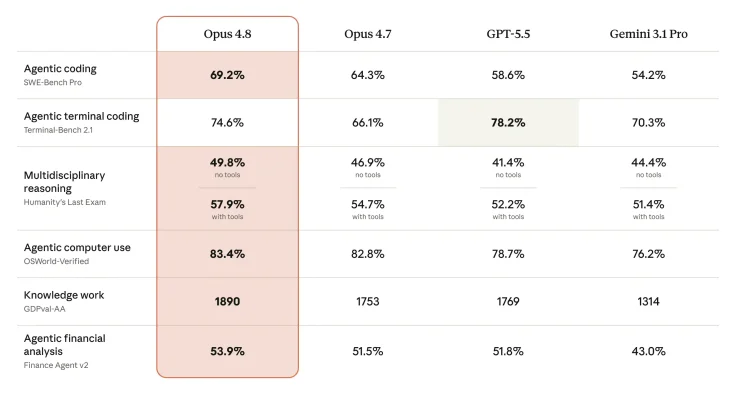
In the SWE-Bench Pro benchmark, which assesses the AI’s ability to correct real coding errors, Claude Opus 4.8 achieved 69.2% compared to 64.3% in the previous version and 58.6% in OpenAI GPT-5.5. In the OSWorld test, which analyzes task execution within operating systems, the result was 83.4%. In the GDPval-AA benchmark, the model scored 1890 points, surpassing the 1753 score of version 4.7. However, in Terminal-Bench 2.1, which measures performance in terminal environments, Opus 4.8 still lags behind GPT-5.5.
In Humanity’s Last Exam (2500 questions from various sciences), Claude Opus 4.8 received 49.8% without using additional tools and 57.9% with them, outpacing three main competitors. Linkup noted that this model successfully passed all cases in the Super-Agent benchmark for the first time, while maintaining a competitive price.
One of Anthropic’s main innovations is the increase in honesty: the model is four times less likely to hide coding errors and is less prone to unverified claims. Compared to Claude Mythos Preview, which remains unavailable to the general public, Opus 4.8 does not exceed it in cybersecurity but has come closer to leading positions in many other tests.
“We tested the model on a set of cybersecurity tests, some of which we used for the first time in the system map. When operating without security measures, Opus 4.8 shows slightly higher capabilities than Claude Opus 4.7; with security measures, its performance is comparable. It still significantly lags behind Mythos Preview in cyber capabilities,” the report on the model states.
Regarding the discussion of sensitive topics, the model maintains the previous level but now more frequently acknowledges the existence of opposing viewpoints during political discussions. Meanwhile, developers noted that Claude Opus 4.8 has become “slightly less satisfied” with its position compared to the previous version.
Implementation of new features and Anthropic’s plans
With the release of Claude Opus 4.8, the company introduced a number of innovations. The most significant of these is Dynamic Workflows in Claude Code, which allows the use of subagents to break tasks into smaller parts within a single session, with results being verified before delivery. This feature is available to users on the Enterprise, Team, and Max plans.
Additionally, there is now the option to select the volume of computations in the model selector (from Low to Max, with High as the default), which affects the depth of responses and token consumption. This is available for all pricing plans. The Fast Mode has become nearly three times cheaper, providing accelerated query execution without loss of quality.
Users can now refine and supplement their queries during task execution — Claude no longer re-reads the entire context. Request limits in Claude Code have also been increased, and a public release of the Mythos family, previously considered too dangerous for open access, is expected soon.
The presentation of Claude Opus 4.8 and the announcement of Mythos took place against the backdrop of Anthropic’s preparations for an IPO. The company recently entered into several partnerships to expand its computing capabilities. On May 28, 2026, Anthropic announced the closure of a Series H investment round, raising $65 billion at a valuation of $965 billion — twice the amount from February this year and above the confirmed valuation of OpenAI.
The raised investments will be directed towards scaling and strengthening Anthropic’s position in the field of high-performance computing. The release of the new model, the announcement of Mythos, and the increase in the company’s valuation intensify competition with OpenAI, although neither party has currently disclosed specific timelines for the IPO.