

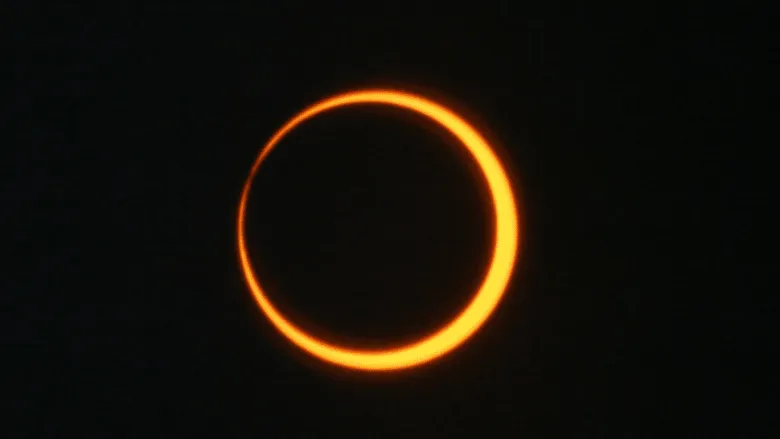
On February 17, 2026, a rare annular solar eclipse will occur over Antarctica, during which a bright “ring of fire” will form around the Moon. The total phase of this phenomenon will only be visible on the southern continent, while partial phases will be visible in Chile, Argentina, and certain regions of Africa.
This is reported by Finway
“The 2026 annular solar eclipse will be the first solar eclipse of the year. On February 17, the Moon will partially cover the disk of the Sun, creating a light ring around the edges. The main visibility path will pass over Antarctica — a continent where scientific stations from various countries are constantly operating. Due to the geography of the Moon’s shadow trajectory, only a limited number of people — primarily researchers and staff at Antarctic bases — will be able to see the total phase of the eclipse.”
Geography and Features of the 2026 Eclipse
The total phase of the annular eclipse will pass over Antarctica, where scientific stations from various countries operate. This phenomenon will primarily be observable by researchers and base personnel, as they are located in the area of maximum visibility. The partial phase of the eclipse will be visible in southern Chile, Argentina, and in countries of southeastern Africa, including Madagascar, Lesotho, and the Republic of South Africa.
A solar eclipse occurs when the Sun, Moon, and Earth align almost in a straight line, and the Moon casts a shadow on our planet. The Moon’s orbit is tilted to the ecliptic by about five degrees, which is why such phenomena do not occur every month. The peculiarity of an annular eclipse is that the Moon is near apogee — the farthest point in its orbit. As a result, its apparent size is smaller than that of the Sun, which causes the light ring to appear around the dark disk.
The highest phase of the eclipse on February 17, 2026, will occur during daylight hours according to Coordinated Universal Time (UTC). The duration of the annular phase at various points along the trajectory will last several minutes.
Differences Between Types of Solar Eclipses
Solar eclipses are divided into total, annular, and partial. During a total eclipse, the Moon completely covers the Sun, and for a brief period, the solar corona becomes visible. This phenomenon was observed by residents of North America in April 2024. During an annular eclipse, such as the one that will occur on February 17, 2026, the Moon does not completely cover the Sun, leaving a narrow bright ring. A partial eclipse means that the Moon only covers part of the disk, not creating a total phase. Visibility depends on the observer’s location relative to the Moon’s shadow.
The next total solar eclipse will occur in August 2026. It will be visible in Greenland, Iceland, Spain, Russia, and partially in Portugal. Residents of certain regions of Europe, Africa, and North America will observe the partial phase of this phenomenon.