

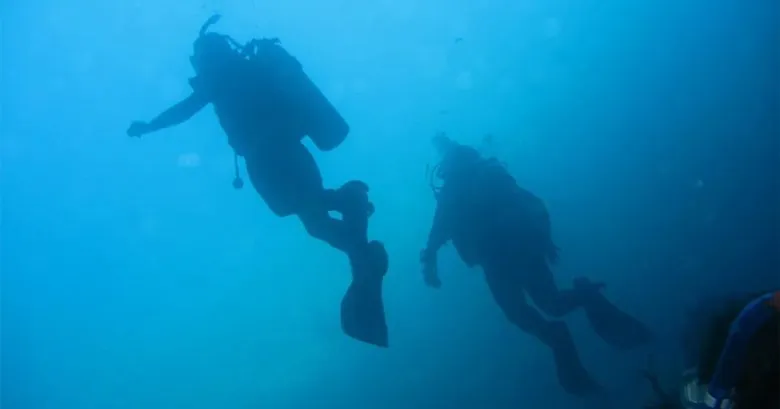
During an underwater research expedition off the western coast of France, scientists discovered unique stone structures estimated to be around 7000 years old. Researchers are convinced that these monumental constructions were created by humans.
This is reported by Finway
Details of the Archaeological Find
As early as 2017, French geologist Yves Fouquet, while retired, was studying the seabed near the island of Sein using laser mapping. He noticed an unusual formation, 120 meters long, and suggested its artificial origin. Later, in 2022, a group of archaeologists began a more in-depth investigation of this area. Initial attempts to dive were complicated by seaweed, so mapping the structure took several years. It was only in 2024 that the presence of this structure was definitively confirmed — a 120-meter wall named TAF1 was discovered, along with about a dozen other stone objects of human origin.
According to scientists, particular attention is drawn to the vertical monoliths and slabs located at the tops of TAF1 and TAF2A. In certain places, the monoliths form two parallel lines, with a distance of about 1.5 meters between them. Such a find had not previously been discovered at similar depths off the coast of Western France.
Possible Purpose and Historical Context
Researchers believe that these structures were built around 5800–5300 BC, when sea levels were significantly lower. There is a suggestion that they may even predate known megalithic complexes in other regions. The purpose of the constructions remains a subject of debate: among the main hypotheses are their use as a complex fishing trap or as a protective structure for the shore. According to one version, during low tide, the structures remained above water, while during high tide, they were submerged.
“In the best-preserved areas, the monoliths form two parallel lines that are approximately 1.5 meters apart.”
Architectural analysis revealed similarities between these objects and fish-trapping structures found in the Molène archipelago, located 40 km north of the island of Sein. However, the scale and complexity of the new find are even more impressive. If the structure indeed served as a fish trap, it could have been used for several centuries, and additional blocks indicate ongoing maintenance. At the same time, some scientists believe that the size of the structure is too large for a fishing trap and do not rule out its defensive purpose, although this version is considered unlikely.
There is an even more mysterious hypothesis: some researchers associate the structure with the legendary city of Ys, which, according to Breton legends, sank nearby and was likely located 10 kilometers east of the find site. However, further research is needed to confirm this theory.