


Following the massive cryptocurrency market crash on the night of October 10-11, 2025, a noticeable change in the behavior of Bitcoin whales has been observed. According to on-chain analysis, large holders have begun actively moving their assets, marking a characteristic feature of a new stage in market dynamics.
This is reported by Finway
Activation of Dormant Wallets and Redistribution of Coins
Immediately after the market collapse, long-dormant Bitcoin wallets suddenly became active. On October 14, approximately 14,000 BTC were moved from such addresses, which had not seen any movement for 12 to 18 months. The very next day, coins aged 3-5 years—over 4,690 BTC—were also transferred to other addresses. Since the beginning of 2025, holders of such wallets have moved over 892,000 BTC, which represents a significant portion of the market supply.
Additionally, in the past week, wallets containing coins aged 2-3 years have also become active: within just a few days, 7,343 BTC were moved. One of the Bitcoin whales made a transfer of 2,000 BTC while continuing to hold approximately 46,000 BTC, equivalent to over 5 billion USD.
Increase in Exchange Flows and Indicator Metrics
The intensity of coin movement is confirmed by the Coin Days Destroyed (CDD) indicator, which reached its highest level in the past month in October. The last similar spike was observed back in July 2025 when whale activity caused the price of Bitcoin to drop from 120,000 to 112,000 USD.
Data from CryptoQuant indicates that after October 11, the volume of Bitcoins flowing to exchanges from wallets holding over 1,000 BTC sharply increased. On October 15, large holders transferred 17,184 BTC to exchanges—the highest level for the month.
“This is just a typical redistribution phase, similar to what we observed in previous cycles. Nothing more,” he explained.
The increased influx of assets to exchanges typically serves as a short-term bearish signal, as it may indicate intentions to lock in profits or minimize losses.
Analysts have particularly noted the Exchange Whale Ratio—the ratio of the ten largest incoming transactions to the total volume of deposits on exchanges. After the October crash, this ratio reached a monthly high, indicating increased activity among large players specifically on centralized trading platforms.
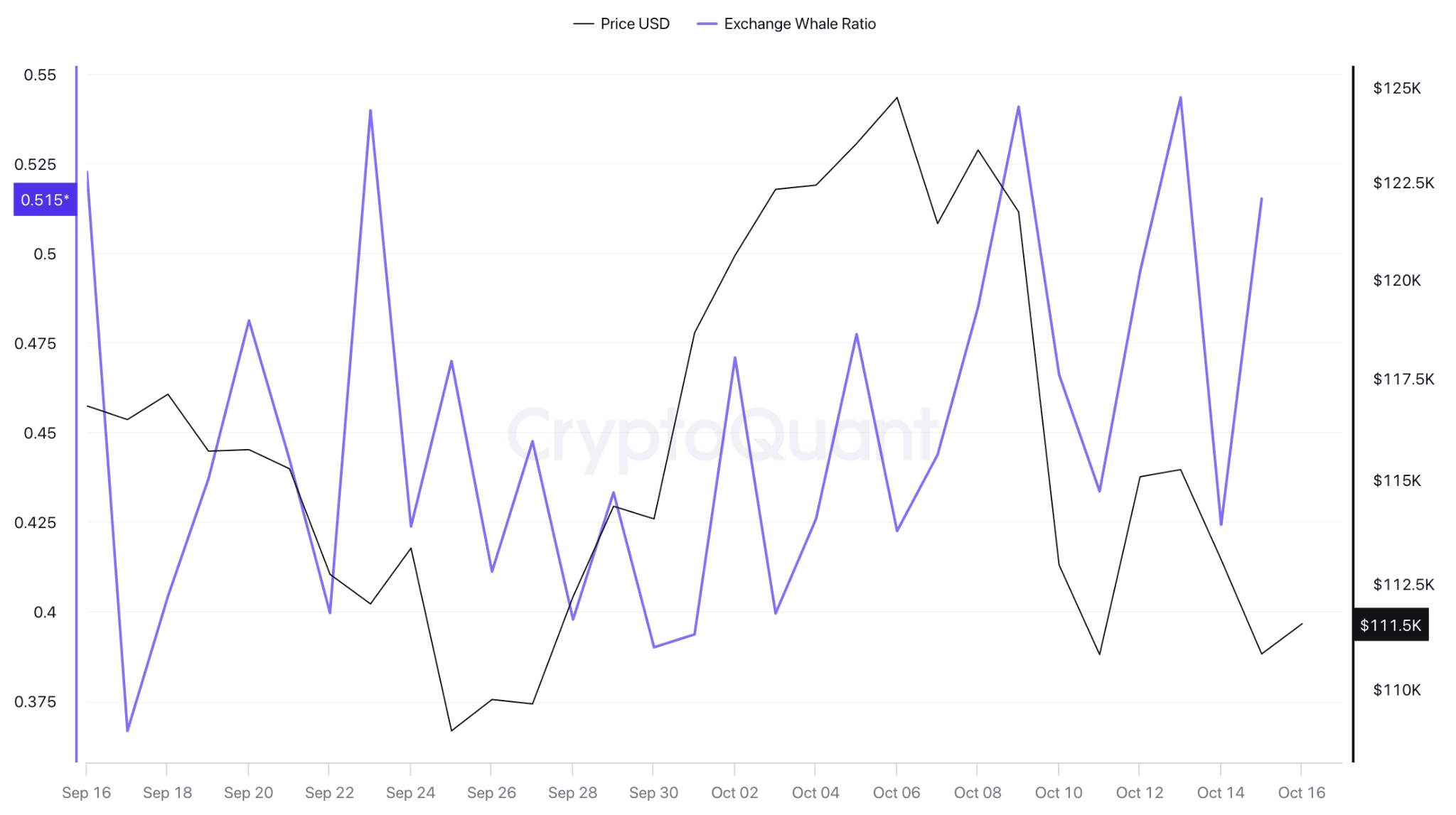
Increased whale activity on exchanges traditionally leads to heightened volatility, as large transactions can significantly impact market liquidity.
It is worth noting that CryptoQuant experts believe that Bitcoin is currently in the late phase of a bullish cycle.