

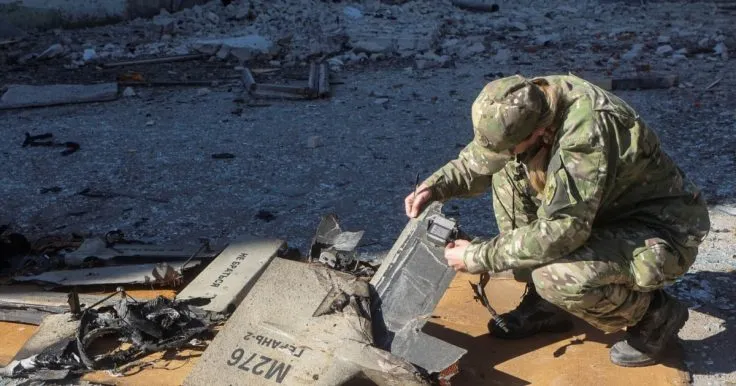
On the night of May 12, the Ukrainian air defense forces destroyed 192 out of 216 strike drones used by Russian troops to carry out a large-scale attack on Ukraine. This was reported by the Air Force of the Ukrainian Armed Forces.
This is reported by Finway
Details of the Night Attack and Consequences
Ukrainian military recorded hits from 25 strike drones at ten different locations, while debris from downed drones was noted in five other places. The attack was launched from the directions of Bryansk, Shatalovo, Kursk, Millerovo, Oryol, and Primorsko-Akhtarsk in Russia, as well as from temporarily occupied Donetsk and Hvardiyiske in Crimea. The occupying forces used various types of drones – Shahed, Gerbera, Italmas, and imitation drones of the “Parody” type.
The local authorities in Kyiv reported debris from a drone falling in the capital. In the Kyiv region, as a result of the night attack, a kindergarten building and several residential buildings in the Fastiv district were damaged.
According to the Minister of Community and Territorial Development Oleksii Kuleba, on the morning of May 12, the Russian army struck at railway infrastructure facilities in the Dnipropetrovsk region. During the shelling, a train driver was injured while trying to reach a shelter.
Systematic Strikes by Russia and Qualification of Actions as Crimes
Russian troops regularly use strike drones, missiles, guided aerial bombs, and multiple launch rocket systems to attack Ukrainian cities and civilian infrastructure across the country. Ukrainian authorities and international organizations classify such strikes as war crimes that are deliberate in nature.
Shelling of the population’s life support systems and healthcare facilities to deprive people of electricity, heat, water supply, communication, medical assistance, and other necessary living conditions is a sign of genocidal actions.
Experts and human rights defenders note that during the large-scale war, Russia is committing actions against the citizens of Ukraine that may fall under the definition of genocide: from calls for the destruction of the Ukrainian nation and shelling of critical infrastructure to the deportation of children and destruction of cultural heritage. In particular, the following has been recorded:
- direct public statements from the Russian leadership about the intention to destroy Ukrainians as a nation;
- systematic attacks on energy, medical, and educational institutions;
- persecution of pro-Ukrainian populations in occupied territories;
- introduction of Russian educational programs to change children’s identities;
- deportation of Ukrainian children to Russia for assimilation;
- destruction of Ukrainian books, looting of museums, and theft of artifacts.
According to the Convention on the Prevention and Punishment of the Crime of Genocide, adopted by the UN General Assembly in 1948, 149 participating countries are obligated to prevent acts of genocide and punish them in both wartime and peacetime. The main characteristics of genocide include intentional actions aimed at the total or partial destruction of a national, ethnic, racial, or religious group, including killings, creating unbearable living conditions, preventing childbirth, and forcibly transferring children.
The Russian leadership continues to deny the facts of targeted attacks on civilian infrastructure, despite numerous evidence of the destruction of hospitals, schools, kindergartens, energy, and water supply facilities throughout Ukraine.