

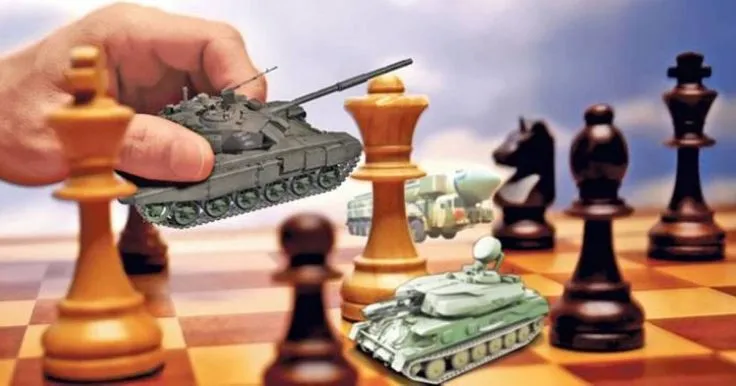
The fourth year of full-scale war places Ukraine at the heart of global political changes, as the world security architecture undergoes profound transformations. Ukraine, as a frontier between the West and Russia, is becoming a key factor in the modern struggle for the future balance of power.
This is reported by Finway
From a Bipolar World to a New Phase of Confrontation
After World War II, the international order was based on the Yalta-Potsdam system, which provided relative stability through a clear division of the world into two camps — the USA and the USSR. The Cold War, with its proxy conflicts in third-world countries, was the price for balance and understandable rules of the game for most states.
With the collapse of the Soviet Union in 1991, a new stage began — Pax Americana. American hegemony ensured the economic and cultural influence of Western civilization. During this period, liberal democracy was viewed as the final form of social order, and Fukuyama’s concept of the “end of history” gained wide popularity. However, the onset of the Russo-Ukrainian war called these ideas into question, and the forecasts of a quick Ukrainian victory made at the beginning of the conflict proved to be overly optimistic.
An important feature of the Pax Americana period was the criticism from Western intellectuals, especially from leftist, neo-Marxist circles. They emphasized the capitalist and imperialistic essence of the Western model, often ignoring the risk of the global structure fracturing into several warring empires. With the onset of the great war, many Western thinkers began to see Russia as a defender against American capitalism, justifying its aggression.
“Many Western thinkers, including quite prominent ones, began to justify Russian aggression simply because Russia, in their view, opposes the destructive influence of the capitalist system, of which the USA is the embodiment.”
New Order: Competition of Empires and Ukraine’s Role
With Trump’s rise to power in the USA and the strengthening of isolationist tendencies, the global system entered a phase of competition among several major centers of power. Tensions are rising in the Middle East, China is becoming more active in Asia, and Russia is trying to return to imperialistic policies of buffer states, where Ukraine has traditionally occupied a key place.
In the current conditions, the models of coexistence of global powers again resemble Hobbes’ “war of all against all.” A new global social contract has yet to be formed, and the centers of power are redistributing the world, establishing new rules and spheres of influence. Ukraine has become a point of bifurcation for the entire continent in this process.
European countries, realizing the necessity of independently ensuring their own security, actively support Ukraine. Assistance is provided not only for humanitarian or altruistic reasons but also to strengthen their own defense potential. Ukraine allows Europe to rearm and prepare for possible future challenges.
After the war with Russia concludes, Ukraine may fully integrate into the Western European power bloc, opening up prospects for membership in key political and economic structures of the continent, including the European Union.
Today, Ukraine has become the point where the world order is undergoing another phase of imperialistic confrontation, as has happened in history before. The optimistic view of our state’s future in the European order is shared by the renowned historian Timothy Snyder, although this order is likely to retain a militaristic character for a long time to come.