

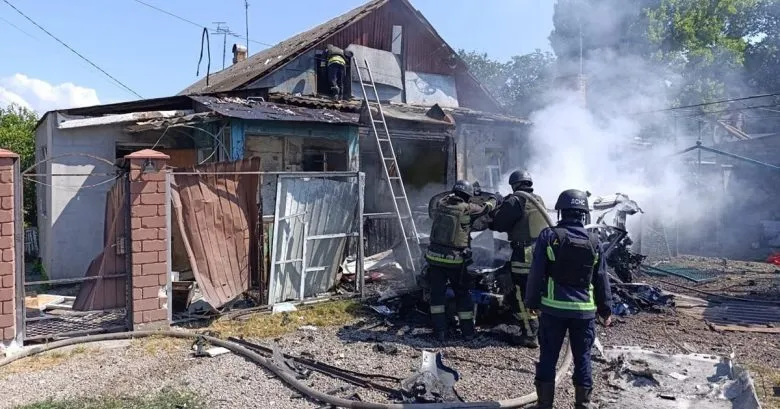
Throughout the day, Russian forces carried out about 50 attacks on three districts of the Dnipropetrovsk region, using artillery and drones. This was reported by the head of the Dnipropetrovsk Regional Military Administration, Oleksandr Hanzha, on the evening of April 28.
This is reported by Finway
Casualties among civilians and destruction
According to official information, as a result of the shelling, two residents of the region were killed, and another 11 people were injured. The Nikopol district suffered the most, where infrastructure and residential buildings in the district center, as well as in the Pokrovsk, Chervonohryhorivka, Marhanets, and Mozolev communities, were damaged.
In particular, five people were injured in the Nikopol district. Among them, an 82-year-old woman is in serious condition in the hospital. Two men aged 20 and 44, along with a 78-year-old woman, have been hospitalized in moderate condition, while a 66-year-old man is receiving outpatient treatment.
In Kryvyi Rih, one person was killed as a result of the shelling, and six others were injured. Four men were hospitalized in moderate condition, while two others are being treated at home.
“The Russians also targeted the Raivska community in Synelnykove. One person was killed,” added the head of the region.
Scale of shelling and international legal assessment
Russian military forces regularly use various types of weapons, including strike drones, missiles, aerial bombs, and multiple launch rocket systems, conducting strikes on Ukrainian cities and civilian infrastructure across all regions of the country.
Ukrainian authorities and international organizations classify such attacks as war crimes of the Russian Federation and emphasize their targeted nature. According to their assessments, shelling of life-support systems and medical facilities aimed at depriving people of electricity, heat, water supply, communication, and medical assistance has signs of genocide.
Human rights defenders and genocide researchers specifically emphasize that Russia is committing crimes during the large-scale war that may be classified as genocide. This includes public calls for the destruction of Ukrainians, targeted strikes on civilian infrastructure, persecution of pro-Ukrainian citizens in occupied territories, destruction of the Ukrainian intelligentsia, deportation of children, and destruction of Ukrainian books and cultural values.
The UN Convention on the Prevention and Punishment of the Crime of Genocide, adopted in 1948, obliges the participating countries, of which there are currently 149, to prevent and punish such actions in both wartime and peacetime. Genocide is defined as acts aimed at the complete or partial destruction of a national, ethnic, racial, or religious group.
The official Russian authorities reject accusations of targeted attacks on civilian infrastructure in Ukraine and deny the facts of killing civilians and the destruction of hospitals, schools, energy, and water supply facilities.