

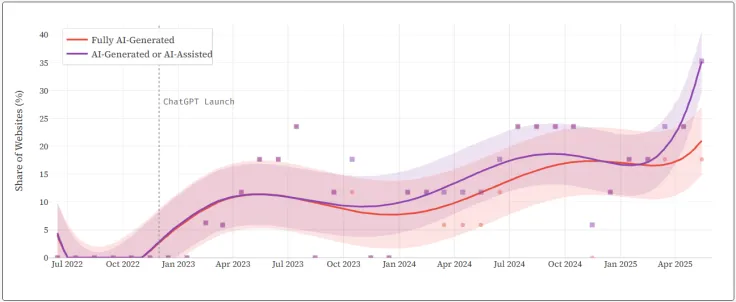
As of mid-2025, over 35% of new websites on the global internet were created with the help of artificial intelligence or with its active use. This data is included in a detailed report by researchers from Stanford University, Imperial College London, and Internet Archive.
This is reported by Finway
Rapid Growth of AI Content Share on the Internet
The study covers the period from 2022 to mid-2025, as it was after the launch of ChatGPT in late November 2022 that experts noted a sharp increase in the use of AI for creating new websites. The Pangram v3 service was used to analyze texts generated by artificial intelligence, which, according to the authors, proved to be the most effective among similar tools.
According to the graphs presented in the report, the share of websites fully created by AI began to rise precisely from mid-2022. By May 2025, this figure reached 17.6%, while resources that contain at least some AI content accounted for 35.3%.

The Impact of AI on Content Uniqueness and Perception
The authors also conducted a survey among 853 American users. It turned out that over 50% of them regularly use artificial intelligence tools, and 44% of respondents have a positive attitude towards this technology.

Survey participants were asked to evaluate six potential negative consequences of the spread of AI in the digital environment:
- decrease in the number of unique ideas (semantic reduction);
- increase in the volume of false information;
- shift towards overly positive and “sterile” content;
- epistemic islands (unsubstantiated claims);
- loss of meaning due to the constant growth of AI content (dilution of entropy);
- stylistic monoculture (unification of style, loss of individuality).
In conclusion, the authors confirmed two hypotheses: the semantic similarity of websites created using AI increased by 33%, and the positive tone of such texts rose by 107%. For the other three hypotheses, researchers recorded a reverse correlation, while for monoculture, there was a direct but less pronounced relationship.

Experts emphasize that such a rapid increase in the number of AI websites and content indicates a swift “takeover” of the internet by this technology. However, it also contributes to the spread of similar ideas and styles, affecting the uniqueness of the web.
“After decades during which people shaped it, a significant part of the internet has become defined by AI in just three years. In my opinion, we are witnessing a massive transformation of the digital landscape in a significantly shorter time than it took for its initial creation,” said one of the authors, Jonáš Doležal, in a comment to 404 Media.
Previously, analysts had already reported an increase in concerns about the use of AI among workers, as well as a direct correlation between the frequency of using this technology and the level of fear regarding its implementation.