

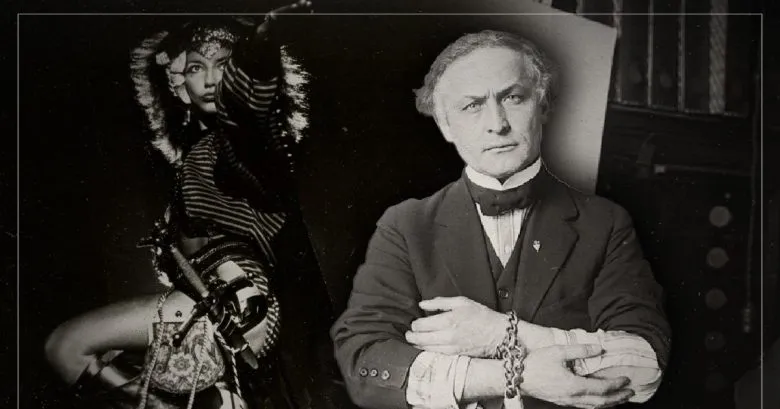
On March 24, the world honors one of the most famous illusionists – Harry Houdini, whose fame has not faded for over a century. His name has become synonymous with phenomenal escapes from locked cells, broken chains, and underwater tricks that captivated audiences and challenged the laws of physics. However, the question remains: what is the true secret of his mastery?
This is reported by Finway
Harry Houdini: The Path to Legend
Harry Houdini, born as Erik Weiss in 1874 in Budapest, was fascinated by the art of magic and circus performances from a young age. However, it was escapology – the art of escape – that brought him true fame. His shows transformed into thrilling spectacles, during which the audience believed they were witnessing a man with supernatural abilities.
Tricks Without Magic: How Houdini Worked
Despite all the rumors, Houdini did not possess mystical powers. His secrets were based on physical training, technical understanding, and psychology. Years of rigorous training made his body extraordinarily flexible and resilient, allowing him to escape from chains or stay underwater longer than an average person. Knowledge of lock and mechanism construction played a crucial role – he often used hidden keys or picks, and sometimes even received locks specially prepared for the trick, although the audience was led to believe it was a coincidence.
A significant part of his success came from his ability to create tension: audiences saw him bound in chains or locked in a waterproof box and were convinced there was no chance of survival. In reality, each performance was the result of precise planning and numerous rehearsals. Houdini also skillfully directed the audience’s attention, distracting them from the real action that was happening unnoticed.
“In reality, Houdini had no supernatural abilities. His ‘trick’ was intellectual, technical, and psychological.”
No less important was the publicity: the illusionist deliberately challenged the police, demanding to be shackled or locked in a cell. His escapes became sensations, and the press repeatedly fueled the myth of his superhuman capabilities.
Belief in the Impossible and the Legacy of the Magician
At the turn of the 19th and 20th centuries, when spiritualism and belief in the supernatural were at their peak, many people sincerely perceived Houdini’s tricks as real miracles. The illusionist himself, by the way, later actively exposed fraudulent mediums, clearly demonstrating that all “wonders” have entirely rational explanations.
However, Houdini never aimed to deceive people in a malicious sense. He amazed, inspired, and urged people to see what the human mind, discipline, and creativity are capable of.
Even today, the name Harry Houdini remains a legend in the world of illusionism. His tricks are still attempted by modern magicians, but only a few manage to achieve such an effect. Houdini proved that true magic is a combination of engineering, physical strength, science, and art.