

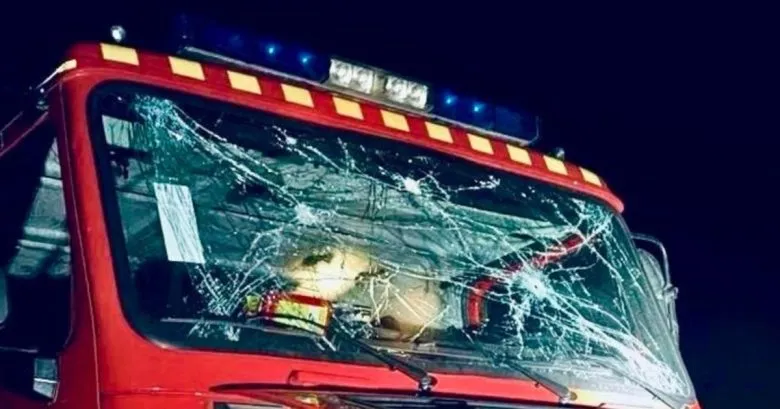
On the night of March 12, Russian drones repeatedly attacked the town of Zolochiv in the Kharkiv region. According to the regional prosecutor’s office, the strikes resulted in injuries to employees of the State Emergency Service (SES) and a driver from an energy company.
This is reported by Finway
Details of the Drone Attacks on Zolochiv
Early Thursday morning, a “Molniya” type drone hit a fire truck. As a result, six SES rescuers were injured — they were diagnosed with blast injuries and acute stress reactions.
“Six SES employees were injured. They were diagnosed with blast injuries and acute stress reactions.”
Later, around 9:35, another drone — this time a “Lancet” — destroyed a service vehicle of the SES unit, but there were no casualties. Around 11:00, a drone, preliminarily identified as a “Molniya,” attacked a vehicle of the energy company, injuring the driver.
Systematic Strikes and Qualification of Crimes
Law enforcement agencies have opened a criminal case under the article on war crimes. The SES reports that during the aftermath of the Russian attacks, rescuers were subjected to repeated shelling twice. As a result of one of the strikes, a fire tanker was damaged, but there were no injuries at that time.
Russia systematically carries out repeated strikes on already hit targets, resulting in Ukrainian rescuers, medics, and energy workers often being among the injured and killed. The occupiers use a wide range of weaponry — strike drones, missiles, aerial bombs, and multiple launch rocket systems — for mass attacks on cities and civilian infrastructure across Ukraine.
Ukrainian authorities and international organizations qualify such actions as war crimes, emphasizing their targeted nature. Attacks on critical infrastructure, healthcare facilities, and essential services aim to deprive people of electricity, heat, water, communication, and medical assistance.
Such actions exhibit signs of genocide, as evidenced by: public calls from Russian leadership for the destruction of Ukrainians, systematic extermination of the intelligentsia, deportation of children, persecution of pro-Ukrainian individuals in occupied territories, removal of Ukrainian books from libraries, and looting of museums.
The 1948 UN Convention on the Prevention and Punishment of the Crime of Genocide obliges member states to prevent and punish such crimes even in peacetime. Signs of genocide include the killing of members of a particular group, intentionally creating conditions for its destruction, the forcible transfer of children, and other actions aimed at the destruction of a national or ethnic group.
The Russian authorities deny the existence of targeted strikes on Ukraine’s civilian infrastructure; however, numerous testimonies, including attacks on rescuers and energy workers, indicate otherwise.