

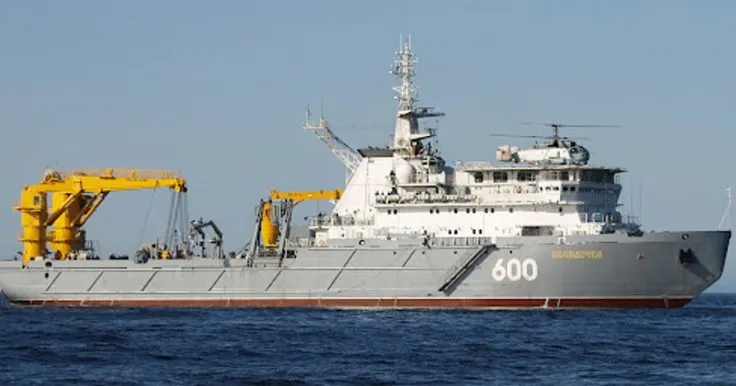
Russia has likely been working for several years on creating systems for deploying ballistic missiles with nuclear warheads on the seabed, using innovative methods. These conclusions have been drawn by Western intelligence agencies after analyzing Russia’s activities in the White Sea, which is part of the Arctic Ocean.
This is reported by Finway
Secret Project “Scythians” and the Role of the Vessel “Zvezdochka”
Particular attention has been drawn by intelligence to the multipurpose vessel “Zvezdochka,” docked in Severodvinsk. This vessel, adapted for transporting heavy equipment even in challenging icy conditions, may be involved in the secret Russian military project “Scythians” (Skythen).
The essence of the project lies in placing missiles in special silos or containers at depths of hundreds of meters underwater. Such installations can remain undetected for extended periods and can be launched remotely. In addition to “Zvezdochka,” the submarine “Saratov” is likely also being involved in the establishment of underwater silos.
Strategic Threat and Historical Context
Research by Western journalists and experts who studied satellite images, Russian scientific bases, and historical documents indicates that Russia may be deliberately deploying ballistic missiles on the seabed. This poses a significant threat to NATO, as such launch sites are extremely difficult to detect and neutralize in the event of a conflict.
“By placing missile silos on the seabed, Russia could maintain its nuclear deterrent capability even under conditions of limited financial resources.”
No official comments regarding the “Scythians” project have been received from either NATO or the Russian Ministry of Defense, while the Russian embassy in Berlin stated that there is no information on this matter.
As noted by Helge Adrians, a naval officer and expert at the German Institute for International and Security Affairs, such a strategy allows Russia to reduce its dependence on expensive submarines or large cruisers while retaining the capability to deliver a nuclear strike.
The idea of placing missiles on the seabed is not new: a similar project was studied by the Pentagon back in 1980 under the name “Orca.” At that time, the Americans abandoned its implementation due to a number of risks; however, Russia returned to this concept in the late 1990s, patenting the relevant developments. For the project, the “Scyth” missile was created—a modified version of the “Sinyava” missile, which is traditionally used to arm Russian submarines.
It was previously reported that the systems “Burevestnik,” “Hazelnut,” and “Poseidon” have weakened Russia’s defense capabilities.