

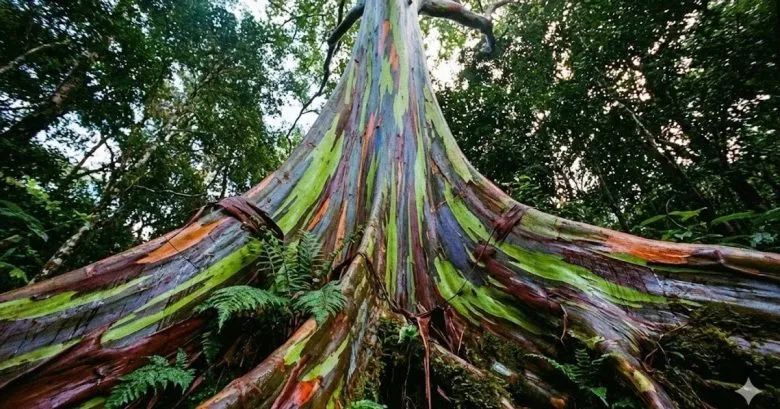
In tropical forests, there exists a unique plant that captivates with its appearance and resembles a piece of digital art. This is the rainbow eucalyptus (Eucalyptus deglupta) — a fast-growing tree that can reach heights of up to 80 meters under favorable conditions.
This is reported by Finway
The native habitat of this botanical wonder is the humid forests of the Philippines, Indonesia, and Papua New Guinea. However, today the rainbow eucalyptus can also be found in other regions with a warm climate, including Hawaii and Florida. Its main feature is the trunk, which impresses with a wealth of shades: from golden-brown and yellow to neon green, red, and even purple.
Why Does Eucalyptus Bark Change Color
Unlike most trees, whose bark thickens and hardens with age, the rainbow eucalyptus undergoes constant renewal. The bark gradually peels off in thin strips, revealing an inner layer of bright green chlorophyll. This process gives rise to a true kaleidoscope of colors.
After fresh bark comes into contact with air, it becomes saturated with tannins — natural substances that protect the tree from fungi. As the tannins mature, the color of the bark gradually changes: first, blue and purple shades appear, followed by red and golden hues, and then brown. The entire cycle repeats, creating a unique appearance for the trunk.
“While the living tree is a marvel of color, its wood is valued for more utilitarian reasons. This species is widely harvested for its valuable timber, which is used for furniture, flooring, and construction. It is also cut down for pulp to make paper, which is actually white,” notes the publication.
Preserving Rare Beauty
The high value of the wood has made the rainbow eucalyptus a target for excessive logging. After processing, the wood loses its colorful properties; however, this does not stop industrial harvesting.
According to the IUCN Red List, this species is at risk of extinction. Its extraordinary decorative appeal is saving it — the rainbow eucalyptus is increasingly being planted in parks and gardens around the world. This gives a chance to preserve the population under human supervision and protect this unique natural heritage.