

Vladimir Putin continues to assert the superiority of the Russian Federation in the war against Ukraine, showing no willingness for compromises. However, experts note that influential figures from his inner circle are trying to urge him to cease military actions, as further prolongation of the conflict could lead to catastrophic consequences for Putin himself.
This is reported by Finway
Escalation of the Situation Inside Russia and Pressure on Putin
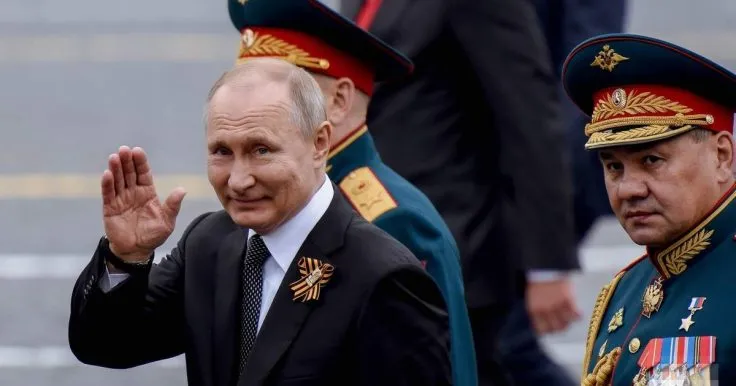
Dr. Mark Galeotti, a historian studying modern Russia, believes that certain hints about a possible end to the war have already slipped into Putin’s speeches. In particular, during the May 9 parade, he told veterans that the war could soon come to an end. Despite the fact that hostilities have entered a positional stalemate, the situation in Russia is escalating: economic and political pressure is becoming increasingly palpable for the elite.
An influential Russian political journalist, commenting on the situation, stated:
“Spending another year and hundreds of thousands of people to capture cities that by then will have turned into ruins seems pointless to them.”
Due to the danger of openly contradicting Putin, his entourage is acting cautiously, trying to subtly influence decision-making regarding the war. Experts see signs of an organized campaign among Kremlin technocrats calling for a change in approach to the war with Ukraine.
Internal Contradictions and Sentiments in the Kremlin
One of the striking signals is the leak to the media of a confidential report prepared for the Kremlin back in February. It directly warns of serious political risks associated with the continuation of the so-called “special military operation” against Ukraine, emphasizing: “We must know when to stop.” The authors of the document stress that further prolongation of the war could become a “Pyrrhic victory” and would require a reassessment of the Kremlin’s fundamental positions. The report even suggests considering the option of freezing the front line, assuming that this could be presented as “thwarting the West’s plans to prolong the war.”
Additionally, results of sociological research have emerged showing a sharp decline in Putin’s approval rating. Although his support stands at 65.6% — this is the lowest level since the beginning of the invasion. Such information typically appears only with the approval of the authorities, indicating a shift in the overall rhetoric.
The “United Russia” party has also released guidelines for its offices ahead of the parliamentary elections in 2026 on how to respond to uncomfortable questions regarding the war. This underscores the growing discontent in society that cannot be silenced by the rhetoric of “victories.”
Despite this, there is no unity in the Kremlin regarding strategy. Some consider it advisable to reduce losses now, while others, like Foreign Minister Sergey Lavrov, insist that peace is only possible after the withdrawal of Ukrainian troops from Donbas. Meanwhile, nationalists and security officials are pressuring Putin to continue active hostilities and general mobilization, while some radicals even call for the use of tactical nuclear weapons.
Putin, known for his caution in making difficult decisions, is currently waiting to see if the spring offensive of Russian troops can change the situation. Experts suggest that he may postpone a final decision until autumn, hoping to use winter for renewed pressure on Ukrainian energy, although such actions in the past have not yielded the expected results.
Additionally, there is a noticeable shift in Putin’s rhetoric regarding Volodymyr Zelensky. If he previously refused to acknowledge his legitimacy, he recently publicly referred to him as “Mr. Zelensky,” which experts consider a small but nonetheless positive step forward.
Furthermore, due to strikes from Ukrainian drones, Russians have begun relocating FPV drone and ammunition depots further from the front line, with partisans documenting one such depot near Mariupol.