

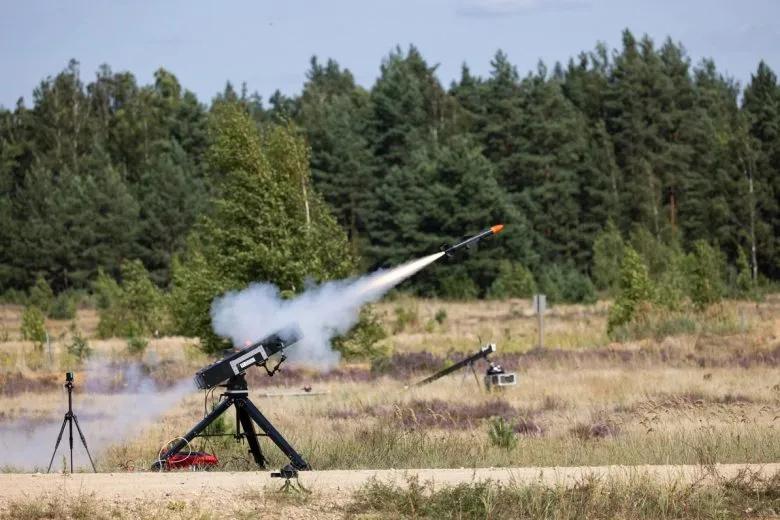
Poland has announced the launch of a new defense investment project in collaboration with the Estonian company Frankenburg Technologies. The state-owned concern Polska Grupa Zbrojeniowa (PGZ) plans to establish national production of Mark I mini-missiles designed to combat drones. This decision lays the groundwork for the creation of a modern industrial platform capable of producing up to 10,000 missiles annually, significantly strengthening the country’s defense industry.
This is reported by Finway
Creation of a New Cluster and Localization of Production
The aim of the joint project is to develop affordable solutions for countering drones, which has become particularly relevant in light of the increasing demand due to the war in Ukraine and the escalation of global security risks. Although the parties have not disclosed the exact investment amounts or implementation timelines, it is known that the establishment of a full-fledged production cluster in Poland is planned. This will significantly enhance the localization of technologies and reduce dependence on imported defense products.
“The project will lead to the expansion of production capacities, the creation of jobs, and the development of related industries, including electronics, materials, and engine manufacturing.”
Development of Technologies and Market Prospects
Polska Grupa Zbrojeniowa is currently considering several sites for the production facility, creating competition among regions in Poland for the right to host the new defense facility and its associated infrastructure. The project is expected to contribute to attracting investments, generating new jobs, and developing related high-tech sectors.
Further investments are also planned for the development of the next generation of Mark II missiles, which will have an increased range of 5–8 km. This opens up prospects for scaling cooperation between Poland and Estonia and deepening technological interaction.
Overall, the initiative demonstrates a trend towards the industrialization of the defense sector in Europe, where there is a growing demand for the mass production of effective and affordable means of combating drones. For investors, this means the formation of a new dynamic market, where key advantages will be determined by the speed of production launch, the cost of products, and the level of technology localization.