

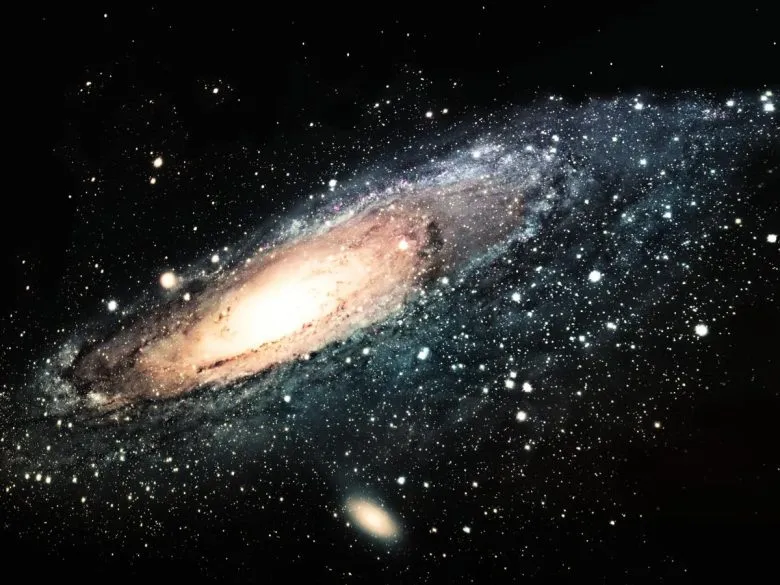
Former Harvard University physicist Michael Guillen has proposed a hypothesis about the physical location of God in the universe — approximately 439 billion trillion kilometers from Earth, which he claims corresponds to the edge of the observable universe.
This is reported by Finway
Guillen’s Idea: Cosmic Horizon and Religion
Michael Guillen published in a column for Fox News his own interpretation of the biblical concept of “heavens,” combining it with the idea of the cosmic horizon — the boundary beyond which light from the most distant objects has yet to reach Earth due to the accelerated expansion of the universe. According to him, the cosmic horizon may be the realm where timeless and immaterial entities exist, which, in the physicist’s view, resonates with religious descriptions of God.
“The cosmic horizon is not a physical ‘wall,’ but a limit to what we are capable of seeing, as light from more distant regions of the universe has not yet had the chance or may never be able to reach Earth due to its accelerated expansion. Guillen asserts that at this boundary ‘time stops,’ and beyond it lies a hidden universe suitable for ‘the existence of light-like entities.'”
Position of the Scientific Community
At the same time, astronomers and physicists emphasize that modern cosmology does not support the idea of time stopping at the cosmic horizon. According to accepted models, this phenomenon is explained by the observational effect: due to the stretching of light in expanding space, events appear to be slowed down, but in reality, they do not cease. Scientists also stress that the cosmic horizon itself is a relative boundary that depends on the observer’s position, rather than a specific location in the universe.
Experts consider Guillen’s idea to be poetic but scientifically unfounded, as it combines cosmological concepts with religious beliefs, relying on speculative assumptions that are not supported by current data in physics and astronomy.