

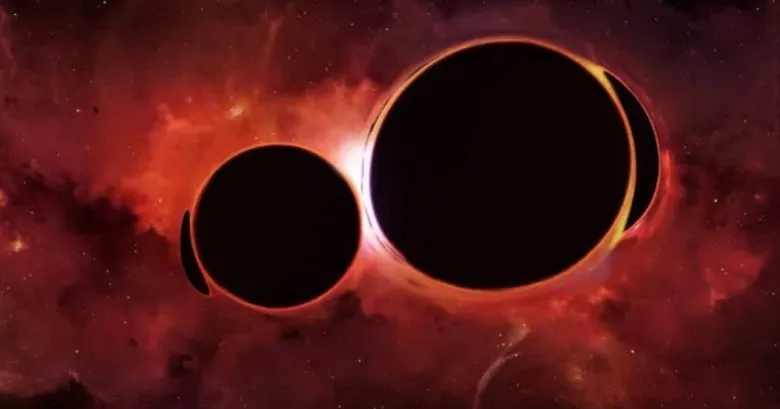
Astronomers are predicting a massive cosmic event — a collision of two supermassive black holes will occur in the Markarian 501 galaxy, located approximately 500 million light-years from Earth. Each of these black holes has a mass a billion times greater than that of the Sun, and the consequences of this merger could be felt throughout the Universe, including on our planet.
This is reported by Finway
Discovery of the Double Blazar and Its Features
During the study, astronomers detected a pair of black holes emitting powerful jets of energy into space and gradually moving closer to each other. Using modern radio telescopes, it was found that instead of a single energy flow typical of blazars, Markarian 501 exhibits another hidden jet. This indicates the presence of a second supermassive black hole at the center of the galaxy.
Blazars are active nuclei of massive galaxies where the central black hole consumes matter, forming a hot plasma disk that emits vast amounts of light. One of the unique features of blazars is that the energetic jet is always directed towards Earth.
Consequences of the Future Merger for the Universe and Earth
Researchers have established that the two black holes are separated by a distance that is 250–540 times greater than the distance from Earth to the Sun (about 150 million km), which is relatively small by cosmic standards. Scientists predict that within less than 100 years, these objects will merge, forming an even larger black hole with a mass ranging from 100 million to 1 billion solar masses.
As a result of the merger, there will be a powerful release of gravitational waves — ripples in spacetime that may exceed the strength of waves recorded during previous similar events. These waves will propagate throughout the Universe and are expected to reach Earth. Modern gravitational wave detectors on our planet will be able to capture this signal, providing new data about the nature of black holes and their interactions.
“Researchers believe that when the black holes inevitably collide, they will release gravitational waves, that is, ripples in the fabric of spacetime that could be more powerful than the waves from previously studied black hole mergers.”
The discovery of the double supermassive black hole in Markarian 501 and its future merger opens new horizons for understanding the structure of the Universe and will also aid in studying the physical processes occurring during such cosmic catastrophes.