

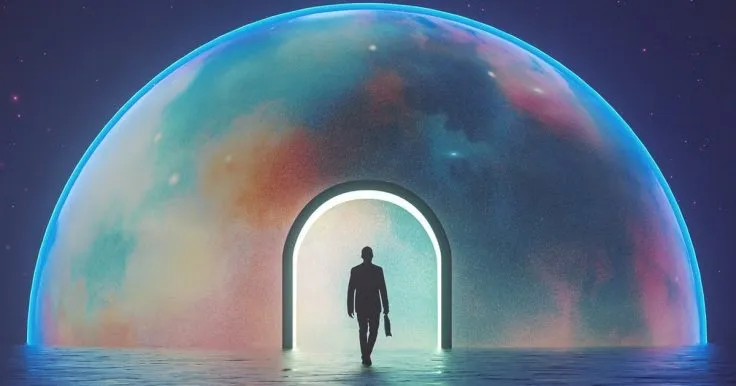
Some modern physical theories do not dismiss the existence of a multiverse, in which our Universe is just one of many possible realities. The idea of parallel worlds captivates not only science fiction creators but also serious researchers seeking answers to the mysteries of the origin and structure of the cosmos.
This is reported by Finway
Cosmological Hypotheses about the Multiverse
After the Big Bang, according to cosmological models, our Universe underwent a brief phase of rapid expansion — the so-called cosmic inflation. During this period, minor quantum fluctuations in the structure of space could have grown to scales that formed the galaxies we observe today.
American physicist Andrei Linde proposes the hypothesis that beyond the visible part of the Universe, at even larger scales, these quantum fluctuations created regions with entirely different physical parameters. The masses of particles, the intensity of gravity, or even the possibility of life existing there could differ radically from what we are accustomed to.
Linde suggests that cosmic inflation may have stopped only in the part of the Universe we can see, while in other regions it continues to this day. This would theoretically lead to the formation of countless “bubbles” of space, each of which is a separate Universe with unique properties.
“Cosmic inflation stopped in the Universe we can see. But it may have continued in other places, says Linde. This could lead to an endless explosion of new bubbles of space with unique properties. In fact, they would represent different Universes”
If our Universe is just one of many, it is quite logical that somewhere the conditions arose that favor the emergence of life. By this logic, even the collision of our Universe with other “bubbles” could leave traces in the relic radiation — the light that remains after the Big Bang.
The Multiverse in Quantum Physics
Another popular theory about parallel worlds is based on the laws of quantum mechanics. According to it, until the moment of observation, an elementary particle can exist in several states simultaneously. When a measurement occurs, only one of the many possibilities is registered, explains physicist Paul Halpern.
This raises the question: what happens to the rest of the possibilities? One hypothesis states that all alternative scenarios unfold in parallel but in separate realities. In each of them, there is its own observer who sees only their version of events.
This approach allows us to suggest that we live in a multiverse where every decision or event spawns a new branch of reality. At the same time, none of the observer’s versions can learn about the existence of others, as they are separated by parallel worlds.
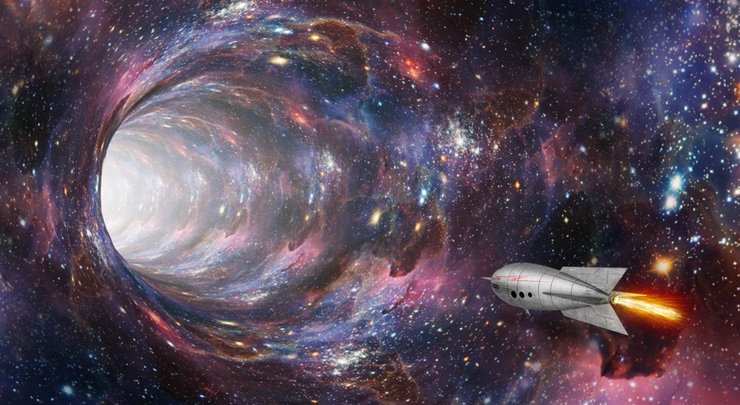
Theoretically, even tunnels in spacetime, known as wormholes, could connect different realities. However, creating such structures would require colossal energy and mass, which is currently unattainable with modern technology, notes Halpern.
Physicists also consider the idea that the Universe may be unstable and exist in a temporary state that could potentially change or disappear. This underscores how much is still unknown hidden in the laws of nature.