

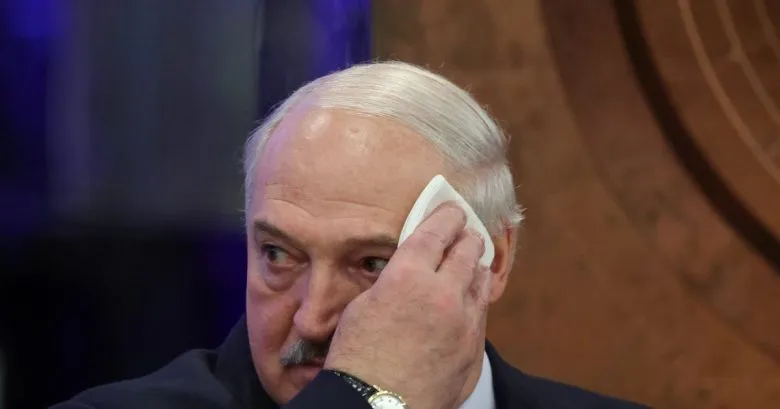
Alexander Lukashenko, who leads the Belarusian regime, openly criticized the country’s government for its inability to achieve most of the planned economic indicators for 2025. During a government meeting held on October 16, preliminary results of the economy’s performance and strategic plans for the next year were discussed.
This is reported by Finway
Three Failed Indicators and Reasons for Economic Decline
Lukashenko noted that a recession continues in several key industrial sectors, and three out of five main forecast parameters remain unmet. In particular, this concerns the growth of gross domestic product (GDP), export volumes, and control of inflation levels. According to him, Belarus’s GDP grew by less than 2% over the first eight months of 2025.
“In several traditional industrial sectors, a recession continues. Three out of five key forecast parameters for this year (so far) are not being met. The gross domestic product has increased by less than 2% over the past eight months,” Lukashenko said.
Among the main reasons for the failures, Lukashenko highlighted the economic decline in Belarus’s main trading partner, the Russian Federation. In his opinion, the government has failed to respond adequately to external challenges.
Uncertainty of Forecasts for 2026
Lukashenko expressed doubts about the realism of the GDP growth plan for 2026, which the government set at 2.8%. He emphasized the need to develop a “realistic yet ambitious” economic development scenario, considering the ambiguous situation in the market.
The head of the Belarusian regime also stressed the importance of the precise functioning of the mobilization economy in the context of the ongoing recession in the country’s main market. Traditionally, he placed the responsibility for economic problems on the government.
Lukashenko added that in the current situation, it is difficult to focus on macroeconomic issues due to the tense geopolitical environment — “on one side of the fence, war is already raging, while on the other, people are rushing toward it at full speed.”
At the same time, in September, the Ukrainian Foreign Intelligence Service stated that Lukashenko had intensified pressure on the country’s banking sector in search of additional funding to support the economy.