

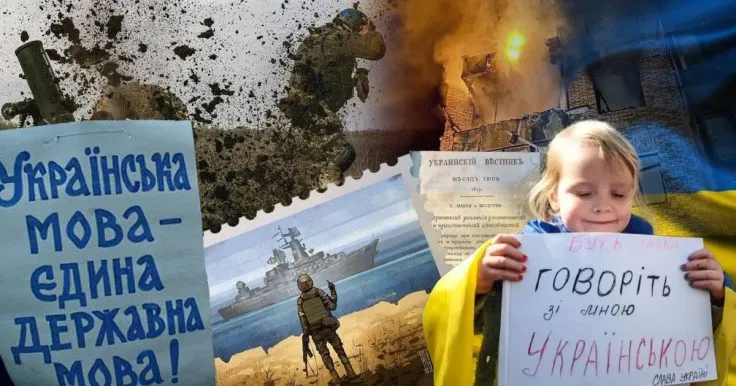
On May 30, 1876, a symbolic date in Ukraine’s history, Emperor Alexander II of the Russian Empire signed the Ems Act. This document significantly restricted the use of the Ukrainian language in the public sphere, imposing a ban on publishing books, staging theatrical performances, and other forms of usage. Over 150 years have passed since then, but the issue of preserving the Ukrainian language remains one of the key aspects in the fight for national identity, especially during the full-scale war when Russia attempts to once again eliminate Ukrainian from the occupied territories through educational, media, and administrative policies.
This is reported by Finway
Russification: Stages, Mechanisms, and Consequences for Ukraine
The policy of Russification in Ukraine began during the Tsarist era, took on new forms during the Soviet period, and continues to this day. Oleksandr Bondarenko, head of the Department of East Slavic Philology at Taras Shevchenko National University of Kyiv, notes that the harshest methods of pressure were applied specifically in the USSR. While there was a period of so-called cultural revival at the beginning of Soviet power, large-scale repressions soon unfolded, aimed not only at banning the language but also at the physical and moral destruction of its bearers.
“But Soviet policy was also very cunning. Speaking Ukrainian was seemingly allowed, but it had to be as similar to Russian as possible. For example, native Ukrainian words were gradually displaced.”
Researchers note that even in dictionaries from 1938, many authentic Ukrainian words were marked as “archaic” or “dialectal,” while words similar to Russian were brought to the forefront. The concept of a “Soviet people” was formed, where the dominant language was to be Russian, and all other nationalities were effectively merged into a single imperial mass. The consequences of such a policy are still evident today — even within Russia, peoples are trying to preserve their identity in the face of centralized pressure.
The Language Issue as a Key Front in the Modern War
Language remains an object of manipulation and a means of influencing consciousness. Russia consistently includes the issue of the Russian language and church in “peace agreements,” attempting to maintain control over the information space. According to Bondarenko, language is a tool of cognitive and mental wars that Russia is waging against Ukrainian society. Such conflicts are not unique to Europe, as, for example, in the Czech Republic, the language issue became a catalyst for national revival.
The myth of the “three brotherly nations” is a typical imperial construct that was actively promoted in the USSR. However, modern linguistics proves that the Ukrainian language has an independent and continuous development, with roots tracing back to the Proto-Slavic community formed specifically in the territory of Ukraine and Belarus. Surzhyk, on the other hand, is a result of prolonged imperial policy, but for many, it has become a transitional stage towards returning to the true Ukrainian language.
How New Words Are Born and Language Culture Changes
New Ukrainian words usually emerge in the media space, social networks, and blogs. Linguists merely document this process in dictionaries, rather than artificially creating words. The popularity of new terms is determined by society, and often viral memes, quotes, or expressions become markers of modern Ukrainian language. A striking example is the phrase “Russian warship,” which, although said in Russian, became a symbol of resistance and entered the cultural code of Ukrainians.
In Russia, on the contrary, euphemization is widespread: attempts to avoid direct names for war and losses. The Ukrainian language, however, is enriched with new expressions that reflect the unique experiences of the people in wartime conditions.
It is possible to cleanse the Ukrainian language of Russianisms, but this process is lengthy and depends on the popularization of Ukrainian-language content — films, music, games, blogs. Family upbringing and the creation of a natural language environment for children play an important role. The emergence of Ukrainian-language products even in areas such as computer games generates significant resonance, surprising Russian users.
Ukrainian swearing significantly differs from Russian, as it is traditionally related to everyday themes rather than sexual ones. The address “pan” and “pani” is a return to an ancient Ukrainian tradition that was displaced by Soviet practices of addressing by patronymic. The modern language culture of Ukraine is gradually returning to its roots, contributing to the restoration of true national identity.
According to research, the level of knowledge of Ukrainian among the youth is rising, although in everyday life, teenagers do not always actively use the language. However, the overall trend indicates a revival of the Ukrainian language’s position, despite prolonged attempts to displace it by imperial regimes.