

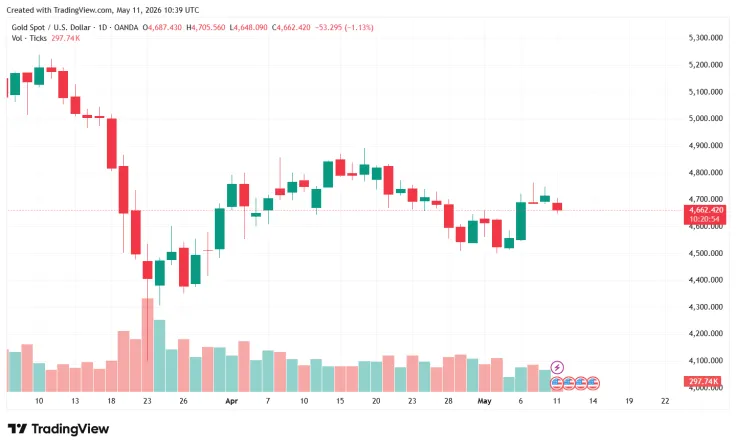
Over the past day, the price of gold has dropped by more than 1%, falling to $4648 at its peak, according to TradingView data. This decline occurred against the backdrop of weakening investment inflows into gold and the influence of geopolitical factors. Experts say that this asset is currently considered overbought and is gradually losing its status as a safe haven during heightened risks.
This is reported by Finway
Gold and Bitcoin Dynamics: Inverse Correlation
At the time of preparing this material, gold was trading at $4662 per ounce, showing a reversal from the previous rise observed in early May. Against this backdrop, Bitcoin managed to exceed the $82,000 mark, although the price later adjusted slightly. Over the last 24 hours, the digital asset showed a modest gain of 0.3% according to CryptoRank.
Both of these instruments are traditionally viewed as means of capital protection during economic instability. However, since the beginning of May 2026, an inverse correlation has been observed between them. On May 6, this indicator reached -0.51 — the lowest value in two months, indicating that gold and Bitcoin are increasingly moving in opposite directions.
“Both gold and Bitcoin are positioned as hedge assets, meaning tools for capital preservation during economic instability and high volatility. However, since the beginning of May 2026, the correlation between them has become inverse.”
Reasons for the Decline: Geopolitics and Decreased Capital Flows
The main reason for the decline in gold prices, experts say, is the reduction in support from institutional investors. Since January 2026, the volume of capital flowing into gold-based exchange-traded funds (ETFs) has been steadily decreasing. The geopolitical situation — particularly the uncertainty in relations between Iran and the USA — is also exerting additional pressure.
Despite the maintenance of a ceasefire, negotiations between the parties have effectively stalled. U.S. President Donald Trump criticized the Iranian initiative for a peace agreement, accusing Tehran of dragging out the process. However, this factor has not had a significant impact on Bitcoin and the stock market — these assets are demonstrating more stable positions than gold.
Analysts note that the current speculative activity in the gold market is linked to the large-scale entry of brokers and ETF providers into this asset using leverage during last year’s price rally. As a result, an increasing number of market participants believe that gold has transitioned into a risky asset status, while Bitcoin, on the contrary, is strengthening its image as “digital gold” and a protective investment tool during turbulent periods.