

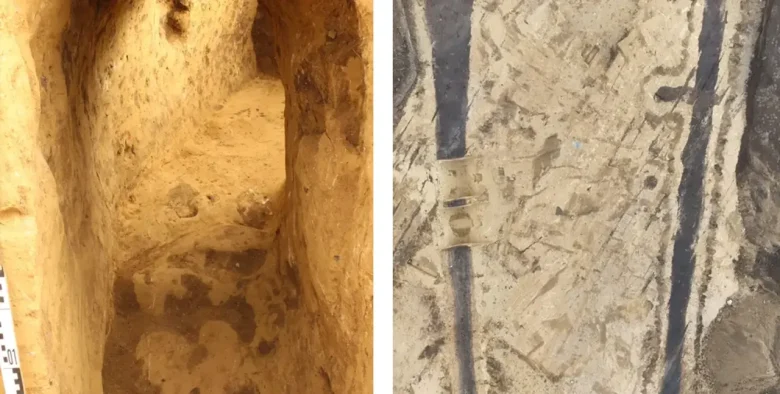
Archaeologists made a unique discovery during preparatory work for the installation of a wind farm near the town of Reinhstedt in Germany. Beneath the layer of soil, within an ancient Neolithic ditch, a hidden medieval tunnel was uncovered. The discovery was made by employees of the State Office for Heritage and Archaeology (LDA).
This is reported by Finway
Features and Structure of the Tunnel
After thorough investigation, it was determined that the found passage dates back to the late medieval period and is a classic example of the so-called “Erdstal” — a narrow underground gallery with a concealed entrance. Similar structures can be found in various parts of Europe, yet the purpose of these tunnels remains a subject of scientific debate.
Researchers propose various hypotheses regarding the functions of Erdstals. Some scholars suggest that these underground passages could have served as temporary storage, places for keeping valuables, shelters during danger, or even been used for ritual purposes.
Archaeological Findings and Historical Context
The tunnel was constructed in a trapezoidal ditch associated with the Baalberge people — representatives of a late Neolithic culture that existed in central Germany between 4000 and 3150 BC. Along the southern edge of this ditch, researchers discovered an oval pit approximately two meters long.
Initially, a large stone slab located on the surface led archaeologists to consider a possible burial. However, during excavations, it was established that the filling of the pit slopes to the north and extends much deeper than traditional graves.
In the upper layer of the tunnel, late medieval pottery, many stones, and several small cavities were found. According to representatives of the LDA, this structure is a typical Erdstal — a system of narrow artificial passages that sometimes contain expanded chambers and are characteristic of regions with hard but workable soil.
“Researchers discovered a narrow passage that curved northwest. Inside the tunnel, a horseshoe, a fox skeleton, small animal bones, and a layer of coal at the bottom were found. The height of the passages varied from just under a meter to 1.25 m, and the width ranged from 50 to 70 cm. In the narrowest section, a pile of stones indicated a deliberate sealing of the entrance.”
Experts emphasize that this unique finding combines medieval underground architecture with a landscape that held significant ritual importance even in the Neolithic era. The LDA suggests that due to the sacred status of this area, which local residents might have perceived as a pagan burial site, it remained little visited, making it an ideal location for creating a hideout.