

Analysts from Wall Street expect that the United States may change its position regarding the conflict in the Middle East. According to their assessments, President Donald Trump’s administration may soon soften its rhetoric, which would contribute to a reduction in regional tensions.
This is reported by Finway
Pressure Index Indicators and Market Reaction
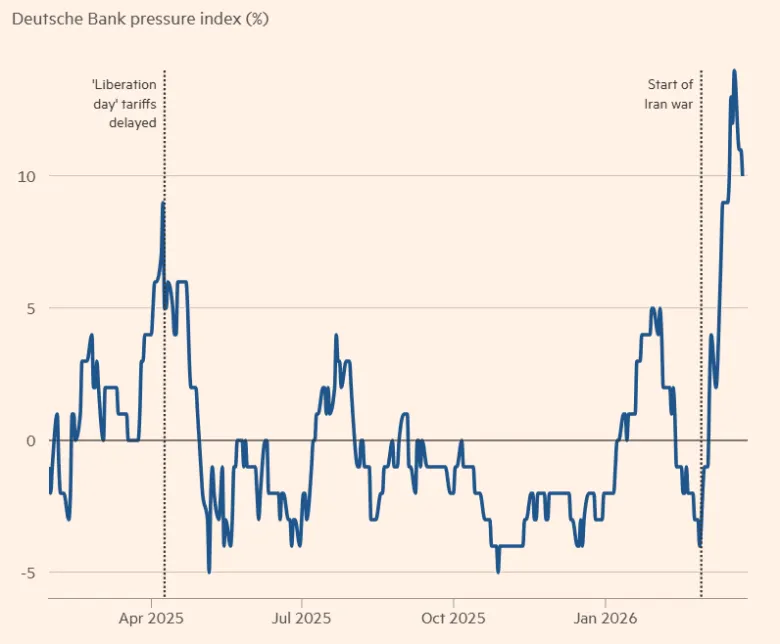
A key indicator of this possibility is the Pressure Index developed by Deutsche Bank. This index tracks four important economic and political parameters: the 20-day average of the S&P 500 index, the yield on 10-year U.S. Treasury bonds, Trump’s approval rating among Americans, and the projected change in inflation over the next year. This week, the Pressure Index reached a historic low, signaling to analysts a potential shift in political direction.
As the dynamics show, the index can sharply rise after significant political events, as occurred in April 2025 during the so-called “Liberation Day,” when the president imposed new import tariffs. Subsequently, after a softening of rhetoric and the cancellation of some tariffs, the Pressure Index fell again.

In the lead-up to Trump’s recent statements about possible negotiations with Iran, the Pressure Index reached its peak, considering data since the president’s inauguration in January 2025. The military confrontation with Iran, which led to the blockage of the Strait of Hormuz and a sharp rise in oil prices, prompted experts to conclude that the U.S. is not interested in a prolonged conflict.
“It is clear that [Trump] is afraid of high gasoline prices. A gas price above $4 is a political killer. On the other hand, one must consider what weighs on his conscience. He does not want to be seen as the one who lost,” quotes the publication Jorge Montepeque, an oil analyst at Onyx Capital Group.
Trump’s approval rating, according to a joint study by Ipsos and Reuters, has dropped to 36%, which is 4% lower than last week. This is the lowest rating since the beginning of his second presidential term.

Additionally, since the beginning of March, the yield on 10-year U.S. bonds has increased by 0.51%, indicating increased pressure in the financial market and expectations regarding inflation. Experts also note a connection between the White House’s rhetoric and the price of Brent crude oil: when prices exceed $100, Trump’s position traditionally softens.
Administration’s Reaction and the “TACO Moment”
Maximilian Uleuer, a strategist at Deutsche Bank who created the Pressure Index, emphasizes the importance of evaluating all four key parameters. If each of them indicates an increased risk, the U.S. administration is more likely to adjust its policy.
Monica Defend, head of the investment institute Amundi, also notes that the Trump administration has become more sensitive to changes in bond yields. If this indicator approaches 4.5%, concern grows in the White House.
In the spring of 2025, the term Trump Always Chickens Out — TACO emerged in the American press, which journalists use to describe decisions made by the Trump administration that involve backing away from tough actions. The term’s author, journalist Robert Armstrong, believes that retreating from failed decisions is a positive phenomenon. He also pointed out that Trump often shows a tendency to back down even before complex negotiations begin, particularly regarding Iran, which has yet to make concessions in talks.
It is worth adding that according to estimates from JPMorgan Chase experts, Bitcoin has become a “safe haven” for investors during the military confrontation between the U.S. and Israel with Iran, highlighting the impact of geopolitics on financial markets.