

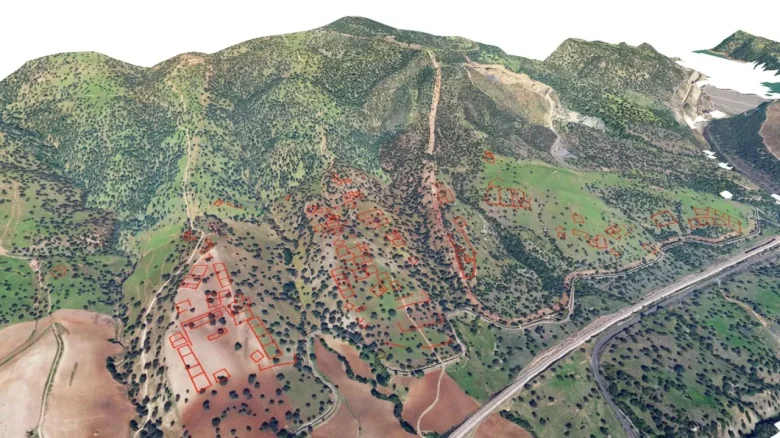
Archaeologists have made a significant step in the search for one of the most mysterious cities of the Islamic world. Underground structures have been discovered near the Spanish city of Córdoba, which may be the remnants of Madinat al-Zahra — a palace city destroyed over a thousand years ago.
This is reported by Finway
LiDAR Technology Aids in Uncovering Traces of the Ancient City
A team of researchers led by historian and archaeologist Antonio Monterroso Checa from the University of Córdoba utilized modern LiDAR analysis, which allows for the scanning of terrain using lasers. During an examination of the eastern outskirts of Córdoba, particularly the Pendolillas mountain range, specialists recorded atypical geometric formations beneath the surface of the ground.
According to the scholar, these underground anomalies correspond to monumental structures: terraces, rectangular and square buildings, as well as a clear orthogonal grid characteristic of the capital cities of the Umayyad Caliphate. The area of the complex reaches 120 hectares, corresponding to the scale of an ancient political center.
The City of Legends: Splendor, Power, and a Tragic Fate
Historians describe Madinat al-Zahra as a “brilliant city” — a symbol of power and technological superiority. According to chronicles, it featured luxurious palaces, terraced gardens, and even mercury pools that amazed ambassadors and subjects. The city combined Islamic, Roman, and Visigothic architectural traditions.
Founded in the late 10th century during the reign of Almanzor, Madinat al-Zahra served as the administrative capital of Al-Andalus. However, in 1010, during a civil war, the city was completely destroyed, marking the end of the Almanzor era.
Historical sources describe Madinat al-Zahra as a “brilliant city” — a symbol of absolute power and technological superiority. Here, according to chronicles, there were luxurious palaces, terraced gardens, and even mercury pools designed to impress ambassadors and subjects. The city combined Islamic, Roman, and Visigothic architectural traditions.
The explored territory in the late Middle Ages was royal property, and in the 16th century, it was used as equestrian grounds for the Spanish crown. Such a long association with power strengthens the notion of the unique significance of this site.
So far, the conclusions are based on the results of remote sensing; however, scientists consider them compelling enough to initiate large-scale archaeological excavations. If the hypothesis is confirmed, Madinat al-Zahra could become one of the most remarkable archaeological discoveries of modern times, reshaping our understanding of politics and urban planning in Al-Andalus.
The global scientific community is closely monitoring this discovery: the “brilliant city” has a chance to return to the historical map as a reality, not just a legend.