

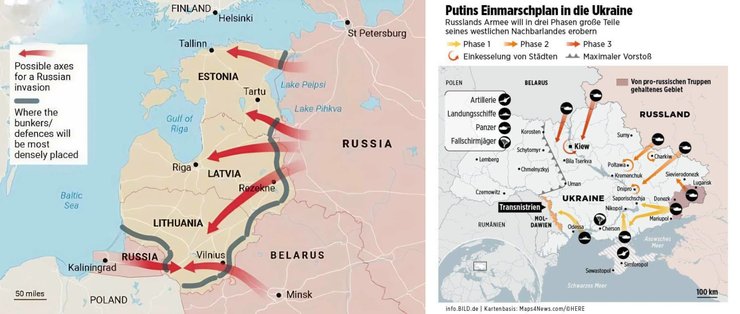
Former Member of Parliament and blogger Boryslav Bereza drew attention to a recent publication by Western media that examines potential scenarios of military aggression by the Russian Federation against the Baltic region. In particular, it discusses a map of possible invasion routes, reminiscent of forecasts that emerged before the onset of the full-scale war in Ukraine.
This is reported by Finway
The Baltic States Prepare for Potential Threats
In his Facebook post, Boryslav Bereza noted that the German publication BILD released a map showing probable directions of Russia’s offensive towards Estonia, Latvia, and Lithuania. He recalled that back in 2021, the same publication published similar materials regarding Ukraine, which at the time were met with skepticism; however, the situation has changed: the Baltic countries are taking the risks seriously and are actively preparing for possible actions by the aggressor.
In Estonia, training is taking place not only for the regular army but also for volunteer units, including the Kaitseliit, and drone operator units are being actively developed.
“And they are also preparing drone pilot units and much more. Strange, these Estonians, right?”
The released map indicates that Russia may consider a multi-directional offensive on the Baltic states not only from its own territory but also through the Kaliningrad region and Belarus. The main targets identified are the capitals — Tallinn, Riga, and Vilnius.
NATO’s Defense Strategy for the Baltics
The German publication BILD, citing military expert Carlo Masala, reported that NATO has developed detailed defense plans for Estonia, Latvia, and Lithuania, which are considered a single operational space. In the event of a threat, the actions of allies must be maximally coordinated.
According to the expert, NATO forces are already partially deployed in Estonia: near Narva, there is a multinational battle group led by the United Kingdom, which serves as the frontline of defense. However, Narva, a border city with a predominantly Russian-speaking population, remains the most vulnerable point, as there is currently no permanent presence of NATO troops there.
The expert believes that the deployment of Alliance units directly in Narva could significantly enhance the level of deterrence, as in the event of an attack, Russian troops would immediately encounter NATO forces. However, to date, such a decision has not yet been implemented. Meanwhile, German troops leading the NATO brigade in Lithuania can be quickly redeployed to Estonia if necessary, but this could create additional risks for other defense directions.
It is worth noting that Estonia has significantly strengthened the defense of its border territories, and the Nordic countries are ready to provide operational support in the event of aggression. However, as experts emphasize, this does not guarantee the immediate involvement of all Alliance forces.
Additionally, Ukrainian military instructors have joined in training German units, sharing experiences in combat against the Russian invasion. This cooperation aims to enhance NATO’s defense capabilities and increase readiness for potential threats from Russia by 2029.