

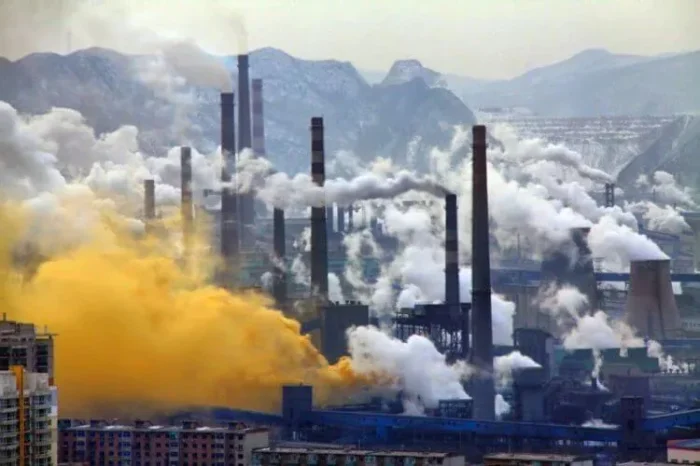
In December 2025, metallurgical enterprises in China that are members of the CISA association recorded a 4.41% increase in total emissions compared to the same period last year. This data was provided by the country’s industry association.
This is reported by Finway
Emission and Energy Consumption Dynamics
Despite the overall increase in emissions, there was a significant reduction in specific harmful substances in exhaust gases. In particular, sulfur dioxide emissions decreased by 16.74% year-on-year, particulate matter by 3.65%, and nitrogen oxides by 19.35%.
Association member enterprises reduced their total energy consumption by 6.4% year-on-year. At the same time, the total energy consumption per ton of steel increased by 4.4%, while comparative consumption rose by 2.5%. Electricity consumption per ton of steel grew by 6.2% year-on-year.
Resource Use and Recycling
The total amount of electricity consumed decreased by 0.5% year-on-year, while self-generated electricity fell by 1.4%. The share of self-generation in the energy consumption structure decreased by 0.57 percentage points, reaching 58.95%. Meanwhile, the production of clean energy increased by 46.9%, including a significant rise in wind energy generation by 415.1% and solar energy by 42.2%.
Water consumption among association enterprises increased by 3.6% year-on-year, although water intake decreased by 1.5%. Water reuse also rose by 3.6%, and the reuse rate increased to 98.49% (an increase of 0.08 percentage points). Water consumption per ton of steel reached 2.55 cubic meters, which is 10.1% more compared to the previous year. At the same time, wastewater emissions increased by 1.7%.
“The recycling rate of steelmaking and blast furnace slag, as well as iron-containing dust, remained above 99%. The use of combustible gases, including blast furnace, converter, and coke gas, exceeded 98%, and the extraction of converter gas increased by 1.7% year-on-year.”
Thus, enterprises maintain high rates of industrial waste recycling and efficient use of energy resources, partially offsetting the increase in total emissions.